
For six years, Journal House has been one of the most considered destinations on the Croisette — a space where The Wall Street Journal convenes brand leaders, executives, and creatives around questions that matter beyond the festival week. The 2026 edition raised the stakes further, organizing its programming around a single tension: how the speed and scale of AI can be harnessed without surrendering the credibility and human judgment that brands are built on.
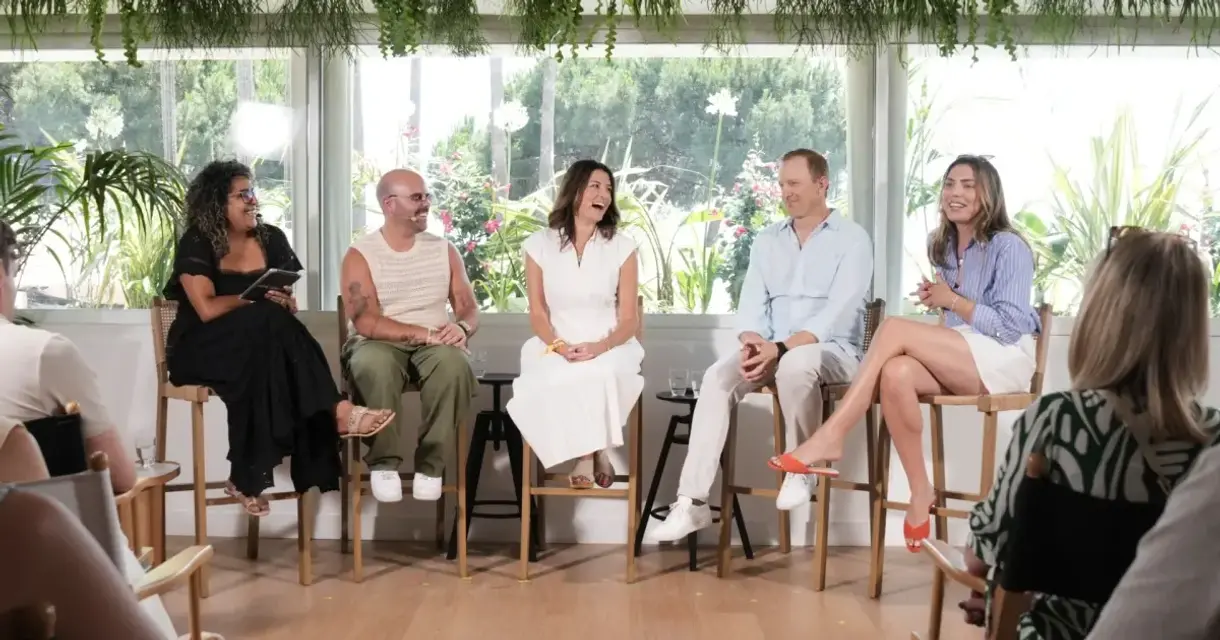
It was the right room for an honest conversation about experiential marketing. On June 22, a panel titled “More Than Memories: Measuring the Impact of Experiential Engagement” brought together four practitioners at the top of their field — moderated by Raakhee Mirchandani of The Trust at WSJ — to work through a question the industry has been circling for years: when someone asks whether a live activation was worth it, how do you answer that honestly?
The answers that followed were less about defense and more about diagnosis. Demand for in-person events has surged — not despite the rise of AI and digital channels, but partly because of them. People are craving the irreplaceable texture of physical presence. And yet the dominant measurement frameworks still lean heavily on what’s easiest to count. Across an hour of conversation, the panel made the case that the industry is further along than its metrics suggest — and that closing the gap between what experiential does and what brands can prove it does is the defining challenge of this moment.
A Framework for Three Horizons
The measurement conversation in experiential has long suffered from a category error: treating all metrics as equivalent because they’re all labeled ROI. In practice, what live events produce operates across very different time horizons — and collapsing them into a single number is where most brands lose the thread.
Melissa Levy, President of Sparks, outlined how the industry’s most sophisticated practitioners are starting to think about this more precisely. The first horizon is immediate: dwell time, foot traffic, QR code scans — the data available within hours that tells you whether people showed up and engaged at a surface level. The second is medium-term: movement across the sales funnel, brand awareness lift, consideration shifts measurable over weeks. The third is the hardest to capture and the most important — whether the interaction produced something that wouldn’t have happened anywhere else.
“We think about measurement in probably three different ways,” Levy said. “Your immediate measurement — your dwell times, your foot traffic, QR code scans. Then your medium-term metrics — how are we moving people across the sales funnel, what kind of engagement do we have, are we measuring brand impact or awareness or consideration? And then finally: was that interaction meaningful? Is this a conversation we would have had here that we’ve not had other places? I think events really should include all of that.”
This matters because most brands are still operating primarily at horizon one — measuring what’s measurable rather than what’s meaningful. And the gap between those two things is widening as the stakes around experiential investment continue to rise.
That gap has a name. The Freeman Company’s proprietary Belief Gap™ framework identifies the distance between brand awareness and genuine brand belief — the kind of trust that converts into loyalty, advocacy, and long-term commercial relationship. In their research, 45 percent of CMOs identified live events as the primary mechanism for closing it. The data underscores what practitioners in the room already knew intuitively: events aren’t a channel for building awareness. They’re a channel for converting awareness into something more durable. Closing the Belief Gap™ requires the kind of human contact, physical presence, and shared experience that no digital channel has yet replicated.
45% of CMOs said the way to help fill that gap is events — which this team here fundamentally believes in. People are getting it. I just think they don’t know how to get started. They’re not yet looking at it as an ecosystem, or as part of a program.
Melissa Levy, President, Sparks
Return on Emotion
Jimmy Knowles named the concept the room was building toward: return on emotion.
“Measurement for experiential — I feel like everybody in this room intimately knows — is not an easy thing to measure,” he said. “The things that fit very squarely and neatly into the Excel chart are the attendance numbers. Where we are trying to get smarter is what I’ve been thinking about recently as return on emotion — how attendance at an event has changed behavior in a consumer, in a customer. That’s the most important thing I think we can be measuring. I have not figured out the answer to how to do that, with full transparency. But I think that’s the thing this industry as a whole needs to get really serious about thinking about, because I think it’s the most tangible product of an event — and that change of behavior is the most important thing.”
Behavior change is the throughline across every sophisticated experiential program represented on the panel. Erin Oles, EVP of Global Integrated Marketing at Salesforce, described how her team follows attendees through their entire post-event journey — watching whether pipeline matures, whether new sales conversations open, whether the signals of genuine intent emerge in the weeks that follow.
“They move with their feet in person,” Oles said, “and then they move with their actions afterwards — with meetings and business decisions.”
Craig McNary, Global Head of Brand and Creative at Xbox, framed it in terms of advocacy. The goal isn’t attendance numbers or broadcast views — it’s building what he called “an advocacy engine.” Are people telling others what they experienced? Are they more likely to share, engage, return?
“For us it’s always about behavior change,” McNary said. “We’re always looking at: did we exceed on shareability — are people talking about the experience? Did we exceed on emotional impact, which is a big one for us, and how deeply they’re connected to the experience they went through? And then clarity of message — are people leaving with a clear understanding of the strength of our content lineup, are they more likely to engage with our ecosystem?”
The shift these practitioners are describing is from event as moment to event as catalyst. The activation is the spark. What matters is what ignites.
We learned that when you use our session recommendations and the AI tool to make an agenda for you, you’re 30% more likely to show up to that content. And if you go to a session featuring a product you’re interested in, the data tells us it closes 70% faster.
Erin Oles, EVP, Global Integrated Marketing, Salesforce
What the Industry Is Still Getting Wrong
The reasons the broader industry struggles to make the measurement case aren’t mysterious. They’re structural — and the panel was candid about them.
Too many brands still treat a live activation as a tactic appended to an existing campaign rather than a strategic anchor around which a campaign is built. When the experience is designed as a supplement, the measurement framework gets built as a supplement too — and you end up counting what’s countable rather than what counts.
The more precise error, as Levy framed it, is entering an activation without clarity on what success looks like across all three horizons before the first design decision is made. “It’s really important to understand what it is you want to try to accomplish,” she said, “put a measurement strategy around it, and then go do it and learn.”
Knowles offered the Canva journey as a case study in learning by doing. He built the experiential function at Canva from scratch — no precedent, no playbook, and a brand whose physical identity had never been defined. The first Canva Create was a 1,000-person event filmed in Sydney and put on the internet. It worked.
“One of the most valuable things I’ve learned over time is giving myself and my team permission to fail,” he said. “That has been such an unlock for us. We use the term ‘throw spaghetti at the wall and see what sticks’ a lot — which I think is really indicative of our very messy, fun, wild, creative process. If you don’t give the team permission to try things, to be creative, to fail, we’re never going to learn, we’re never going to improve.”
That permission is now codified into how Canva approaches scale. Canva Create has grown to 6,000 attendees in Los Angeles, generated $3 million in sponsorship revenue, and become what Knowles describes as a massive content engine — a live event whose most measurable value is the content it generates and distributes for the remainder of the year. The event isn’t the output. The content is.
Measurement for experiential — everybody in this room intimately knows — is not an easy thing to measure. Where we are trying to get smarter is what I’ve been thinking about as return on emotion: how attendance at an event has changed behavior in a consumer, in a customer. That’s the most important thing I think we can be measuring.
Jimmy Knowles, Global Head of Experiential Marketing, Canva
AI Is Making In-Person More Personal, Not Less Necessary
If the measurement conversation is still evolving, the tools available to support it are accelerating.
Oles described how Salesforce has deployed AI across Dreamforce — its 50,000-person flagship event in San Francisco — with measurable consequences. A concierge tool built on its own agentic AI platform handles logistics and scheduling, but more importantly, it personalizes the experience at a scale that was previously impossible.
“I like to think about the idea that we now have this opportunity with AI to make an event more personal than ever before,” Oles said. “Whereas before we would kind of track — we would say, you’re this category of human, we think, and this is the kind of content you might be interested in, and we’d broad-group you. Now we can actually do one-to-one personalized targeting. As you’re registering, we can see who’s coming in, and we can shift the content we’re creating to make the experience better for you.”
The data behind that personalization is striking. Attendees who use the AI-powered session recommendations are 30 percent more likely to show up to the content. When an attendee makes it to a session featuring a product they’re already interested in, the commercial outcome closes 70 percent faster than it would have without that session.
But the more consequential shift may be temporal. For the first time, Salesforce can watch what’s happening inside the event in real time — and adjust before the doors close.
“Usually, we build it, you come, we do the best we can fighting whatever fire is throughout — and then we close it, we send the survey, and we’re like, ‘I wish I had known that,’” Oles said. “Now we know it in real time. We’re getting that feedback from AI and changing things before they close the door.”
McNary extended the conversation to digital reach: Xbox now broadcasts its Game Showcase across YouTube, Facebook, and Amazon Prime, localized into 40 languages. The physical event is the anchor; digital is where scale compounds. Engagement volume, shareability, the depth of the online conversation that follows a live moment — these are behavior-change signals, not separate metrics.
For us it’s always about behavior change. Did we exceed on shareability — are people talking about the experience? Did we exceed on emotional impact, which is a big one for us? And then clarity of message — are people leaving with a clear understanding of the strength of our content lineup, are they more likely to engage with our ecosystem?
Craig McNary, Global Head of Brand and Creative, Xbox
The KPI No One Has Named Yet
The most revealing exchange of the session came when the conversation reached a moment that almost didn’t happen.
Oles described the pressure her team faces every year to approve or kill ideas before Dreamforce — and a developer event where someone pitched dressing 800 attendees as Albert Einstein, breaking the Guinness World Record for the largest gathering of Einsteins, as a way to celebrate Salesforce’s developer community.
“A cute little plug — it would have been so easy for any of us in the leadership team to shut it down,” she said. “Like, ‘I don’t really think that makes sense.’ But at the end of the day, it was the thing. They didn’t take the costumes off. They proceeded to go to a concert wearing these costumes all across San Francisco, and it was this viral marketing moment that honestly was just because it was a really weird, quirky idea we didn’t say no to.”
The lesson, as Oles now frames it for her team: the weird ideas are often the most important ones to protect. “I challenge the team this year, as we’re starting to gear up for our next Dreamforce, to really lean into how we create more joy — how we create those moments for people that you don’t expect, maybe you never really knew you needed, but that will stay with you long after you’ve gone, as the brand affinity and loyalty that comes with it.”
Knowles connected it to a moment from Canva Create 2023 — the Enterprise rap battle, a piece of programming so unexpected it divided the internet the day it ran. Half the reaction called it cringeworthy. The other half called it unmistakably Canva. And then the community showed up.
“In those 24 hours, the shift in the social conversation that I thought was so interesting came from our community,” Knowles said. “It was the people that were like, ‘No, this isn’t cringe. This isn’t weird. This is Canva. And if you don’t get it, like, that’s okay — that’s not for you. But this is their brand, and this is who they are.’ Seeing the community rally behind us, our message, our willingness and boldness to swing big and try something really weird — that sense of community, that brand love, that expression of pride from your customers and community — that’s the ultimate holy grail. Maybe that’s the KPI we should be measuring: how proud of us are they?”
Experiential Is the Strategy
The panel closed where the best conversations do — not with a tidy conclusion, but with a forward-looking provocation.
The brands winning with live experiences, the panel agreed, are those that stopped treating them as line items and started treating them as infrastructure. B2B sectors — technology, financial services, pharma — figured this out first, building event programs that function as structured sales channels with measurement baked in from the start. B2C is catching up fast.
“The B2C clients are also getting it,” Levy said. “The brands that get it — they’re the ones selling the most things. Their stock is strong. They’re understanding the ecosystems, and where live events and experiences fit in for everything we’ve been talking about. How do you create that moment for your fans? Because they’re the ones going out and creating content. They’re the ones that are, frankly, now driving the LLMs. They’re going to help you rise to the top.”
That last point carries particular weight in 2026. As AI-powered search reshapes discovery, the content that communities generate around genuine brand experiences will matter more, not less. Events that earn community pride — the kind that inspires a fan to defend a rap battle or walk across San Francisco in an Einstein costume — produce exactly the kind of authentic, distributed signal that surfaces in AI-powered recommendations.
Return on emotion isn’t a soft metric. It may be the most durable one the industry has. The challenge now is building the tools and the organizational will to measure it.
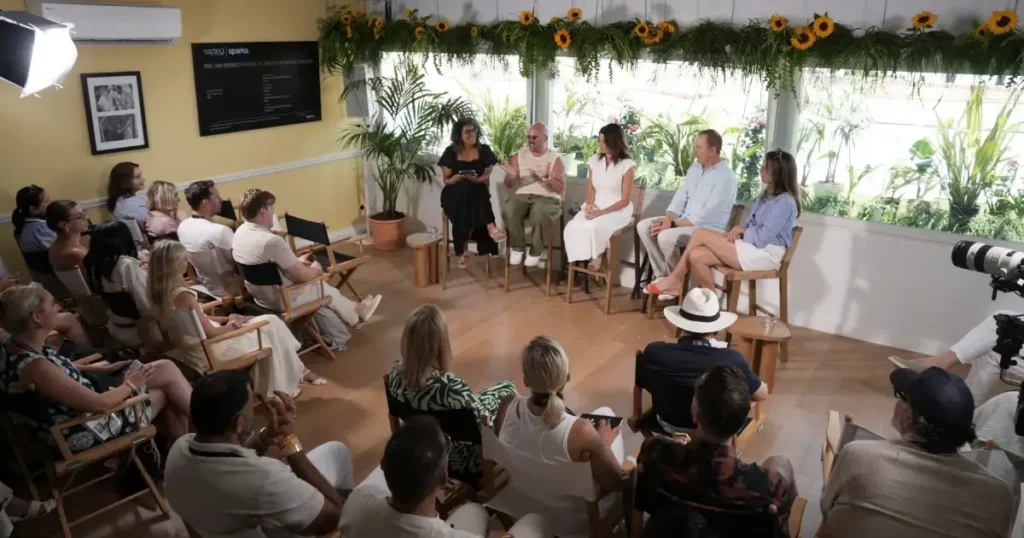
More Than Memories: Measuring the Impact of Experiential Engagement was moderated by Raakhee Mirchandani, Host, The Trust, WSJ, and featured Melissa Levy, President, Sparks; Jimmy Knowles, Global Head of Experiential Marketing, Canva; Craig McNary, Global Head of Brand and Creative, Xbox; and Erin Oles, EVP, Global Integrated Marketing, Salesforce. The session took place on June 22, 2026 at Journal House, Cannes Lions.
For more from the conversation, watch the full panel — produced in partnership with The Wall Street Journal.
Photography by Maurizio Martorana for The Wall Street Journal