
At a Glance
Oncology’s two biggest meetings take place at opposite ends of the year — and of the world. ASCO in Chicago is where the latest breakthroughs are uncovered. This year, announcements included a pancreatic cancer drug that roughly doubled survival, long-term proof for cancer vaccines and bispecific antibodies, and a clear turn toward giving patients less treatment when biology says they don’t need more. ESMO in Madrid is where the field argues about what to do with all of it: who gets the new drugs, when, and how.
Here, we’ll cover the key takeaways from ASCO, preview the ESMO agenda, and compare the two exhibit halls — the big American builds against the quieter, denser European counterparts.
When oncologists assemble in Madrid, Spain for the European Society for Medical Oncology (ESMO) Congress, Oct. 23-27, 2026, the debate is likely to move beyond whether new medicines work to who should receive them, how early, and at what cost. The oncology meeting bookends of ASCO and ESMO are also a contrast in exhibit delivery, attendees, and tone. They are, if you will, a “tale of two cities”.
The June 2026 American Society of Clinical Oncology (ASCO) meeting in Chicago, IL supplied the scientific momentum. Headline results included RASolute 302, in which the KRAS inhibitor daraxonrasib nearly doubled overall survival in metastatic pancreatic cancer, and seven-year CROWN data showing durable disease control with lorlatinib in ALK-positive lung cancer. KEYNOTE-522 strengthened the survival case for perioperative immunotherapy in triple-negative breast cancer, while OPTIMA suggested genomic testing could spare selected patients chemotherapy.[1][2]
The ASCO Annual Meeting once again demonstrated that it is more than a conference — it’s the place to be a part of something much larger. This is where groundbreaking science, clinical innovation, and community connection come together to shape the future of cancer care. As the world’s largest medical conference focused on cancer care, the sheer attendance at this meeting will give you some feel for the impact data presentations and networking interactions can have around this massive disease state conference.
45,700
Total Attendance
36,600
Total Professionals
32,000
In-Person Professionals
4,600
Virtual Professionals
7,350
Exhibitors
2.5M
Sq Ft of Exhibit Space
1,750
Media & Others
22,775
Domestic Attendees (62%)
13,825
International Attendees (38%)
The meeting showcased more than 3,400 abstracts, featuring over 450 oral presentations and 2700 poster presentations.
ASCO 2026: The 10 Takeaways That Mattered Most
- Precision oncology entered a new phase: not just matching drugs to tumors, but matching treatment intensity to biology.[1]
- Pancreatic cancer delivered the meeting’s most gratifying standing ovation.[1]
- Immunotherapy’s next frontier is overcoming tumor invisibility.
- Obesity drugs emerged as one of oncology’s most closely watched “adjacent” stories.
- mRNA cancer vaccines quietly strengthened their case.
- Bispecific antibodies continued their march toward standard of care.
- Antibody-drug conjugates are becoming the oncology industry’s most important platform technology.
- Cell therapy is moving beyond proof-of-concept toward optimization.
- Radiation technology staged a comeback.
- Not every innovation worked — and that may be equally important.
The ASCO Storyline
If ASCO 2025 was about the expansion of targeted therapy and immunotherapy, ASCO 2026 felt like the year oncology became more precise, less invasive, and increasingly interdisciplinary. The biggest winners were KRAS-targeted therapies, ADCs, bispecific antibodies, personalized cancer vaccines, and potentially GLP-1-based metabolic approaches. The strongest strategic message from Chicago was that future cancer care may rely as much on identifying who can avoid treatment as on discovering new drugs.
ESMO’s hotter arguments, according to biomedwoRx: Life Sciences Consulting research, will probably concern implementation. Expect scrutiny of resistance to KRAS drugs, sequencing of antibody-drug conjugates and bispecific antibodies, biomarker-defined treatment, and management of platform-specific toxicities. Artificial intelligence in diagnosis and therapy is an announced program priority.[3] European concerns about reimbursement, equitable access and health-system capacity should give these discussions a sharper economic edge than Chicago’s breakthrough-centered narrative.
De-escalation of care intensity may prove equally important. OPTIMA’s chemotherapy-avoidance message, ASCO’s negative PUMP trial and emerging uses of circulating tumor DNA invite an unfashionable question: When should oncologists do less?
The exhibit hall will delineate the contrast between the “two cities”. ASCO’s 487 booths favored American spectacle: Fennec Pharma installed a toy racetrack and simulators; Boehringer Ingelheim placed a branded boat on a moving “ocean”; Jazz Pharmaceuticals built an enormous pop-up book; and Bristol Myers Squibb fashioned a purple-and-white medical library.[4] It’s worth noting that ASCO has been held in Chicago since 2010 and has committed to being held at McCormick Place through 2028. The ESMO congress regularly changes venues (2025: Berlin, 2026: Madrid, 2027: Barcelona) but always in Europe.
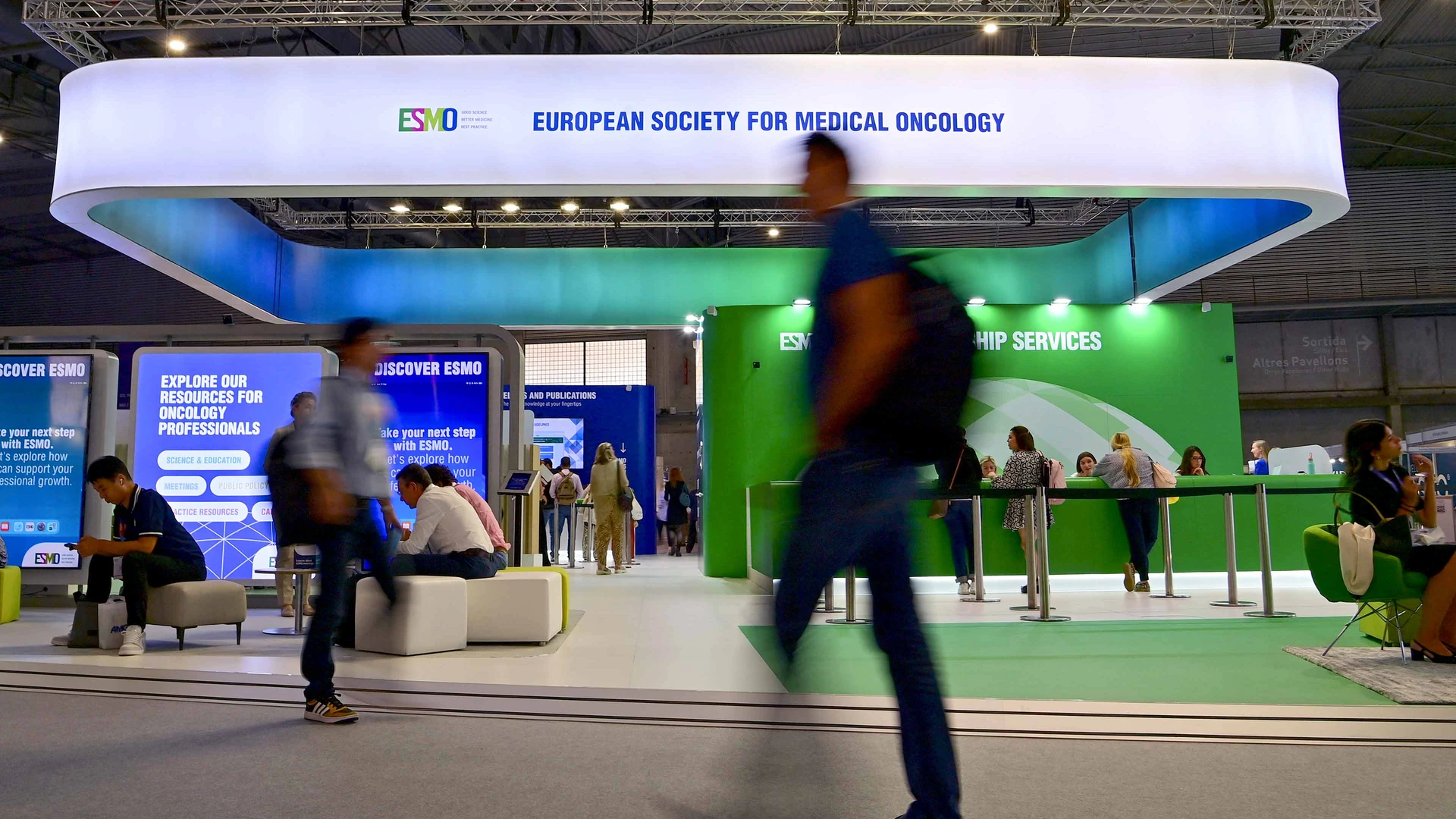
Madrid will still feature towering signs and immersive digital displays, but likely with a more restrained European vocabulary: clinical-data theaters, molecular-testing demonstrations, sustainability cues and access-focused medical-affairs spaces. The industry’s message will evolve from “look at our breakthrough” to “here is how it should be deployed.”
The contrast between American spectacle and European functionality is partly cultural and partly commercial. At ASCO, the exhibit is often treated as a three-day brand launch: theatrical architecture, hospitality bars and gamified attractions compete for attention across McCormick Place. Astra Zeneca’s theatrical curtains, Fennec’s racetrack, Boehringer Ingelheim’s simulated ocean and Jazz Pharmaceuticals’ giant storybook turned scientific messaging into “edu-tainment”.[4] Madrid is unlikely to be austere, but ESMO exhibitors typically must communicate across languages, regulatory regimes and reimbursement systems. Expect modular consultation areas, evidence screens, biomarker demonstrations and small presentation theaters to carry more weight than display sizzle.
ESMO’s published 2026 list already includes AbbVie, Amgen, Astellas, AstraZeneca, Bayer, BioNTech, Boehringer Ingelheim, Bristol Myers Squibb, Daiichi Sankyo, Eisai, Novartis, Pfizer, Roche, Sanofi, Servier and Takeda, alongside diagnostics and data companies such as Agilent, Caris Life Sciences, PathAI, Quest Diagnostics, Siemens Healthineers, SOPHiA Genetics and Tempus.[3]
Exact company exhibit budgets aren’t publicly disclosed, making a dollar-for-dollar comparison difficult. ASCO did identify Daiichi Sankyo, Genentech, Johnson & Johnson and Novartis as platinum sponsorship donors, and Bristol Myers Squibb as gold, but sponsorship tiers don’t reveal total booth-production spending. ASCO Companies appearing at both meetings are effectively funding two different strategies: ASCO’s costly experiential builds for U.S. visibility, and ESMO’s multinational medical-education, market-access and localization effort.
ESMO reported 37,000 participants from 174 countries and 164 exhibitors in 2025[3], suggesting Madrid could equal or modestly exceed ASCO in total attendance while featuring fewer exhibitors and a more internationally fragmented audience. ASCO’s larger commercial population creates greater pressure for visual differentiation; ESMO’s broader geographic mix rewards adaptable, information-dense exhibits.
Ultimately, through these two oncology conferences, we have a chance to experience how the healthcare industry interprets their HCP attendees, integrates the services and healthcare systems of the venue cities, and delivers the education and news about advances in care.
Frequently Asked Questions
ESMO Congress 2026 takes place in Madrid, Spain, October 23–27, 2026.
ESMO 2026 is expected to emphasize the practical use of new cancer treatments, including resistance to KRAS drugs, sequencing of antibody-drug conjugates and bispecific antibodies, biomarker-defined treatment, and management of treatment-related toxicities. Michael W. Young also anticipates debate about reducing treatment intensity, reimbursement, equitable access, and health-system capacity. Artificial intelligence in diagnosis and therapy is an announced program priority.
ASCO exhibits often emphasize large-scale brand experiences, using theatrical architecture, hospitality areas, and interactive attractions to draw attention. ESMO exhibitors must communicate across languages, regulatory regimes, and reimbursement systems. For Madrid, Young expects a greater emphasis on clinical evidence and consultation, with biomarker demonstrations, modular meeting areas, and smaller presentation theaters helping explain how new treatments should be used.
The attendance figures cited in this article are 45,700 for ASCO 2026, including 36,600 professionals, and 37,000 participants from 174 countries for ESMO 2025. These figures refer to different years. The ESMO figure is a historical reference, not a confirmed attendance total for the 2026 congress in Madrid.
De-escalation in oncology means matching treatment intensity to disease biology, including identifying patients who may be able to avoid unnecessary treatment. At ASCO 2026, OPTIMA suggested that genomic testing could spare selected patients chemotherapy. The finding illustrates a broader theme in the article: advances in cancer care can involve identifying when less treatment may be appropriate, as well as developing new medicines.
References
- Common Sense Oncology. ASCO 2026: Important Trials from ASCO.
- Fortrea. Moving Beyond the Podium: What ASCO 2026 Means for the Reality of Trial Execution.
- ESMO Congress 2026 Programme.
- Fierce Pharma. Coffee, racetracks, beaches and more coffee — inside the ASCO 2026 exhibit floor.
About the Author
Michael W. Young is the principal healthcare strategist for Sparks. He leads biomedwoRx: Life Sciences Consulting, a strategic advisory firm working at the intersection of clinical strategy and commercialization for biotechnology, pharmaceutical, diagnostic, medical-device, and clinical-software organizations worldwide. He has received several industry and association awards and brings more than two decades of biopharmaceutical leadership experience, including senior commercial roles at Eisai, Ligand Pharmaceuticals, GSK, Bayer, PPD, PAREXEL, and Klick Health. Michael also serves as a board director for HCEA, the Healthcare Convention and Exhibitors Association.