
At a Glance
- The idea: as generated content spreads, physical interaction gives live events an advantage screens can’t. It gets people to approach, helps them remember, and makes abstract ideas concrete.
- The evidence: half of 1,539 US consumers surveyed prefer brands that avoid generative AI in consumer-facing content, and people remember actions they perform better than what they only hear or read.
- The caveat: research shows people choose physical interfaces and join in, not that they necessarily learn more. The interaction has to carry the message.
- Three mechanism families: immersive momentum (wheels, sliders, cranks), decisive action (buttons, switches, plugs) and invisible magic (a responsive environment).
- Five principles: find the metaphor, design for affordance, design for groups, make it feel good, and measure understanding.
- At Sparks: creative technology is a service, from concept and mechanism design to fabrication and staffed on-site activation.
The more content is generated for us, the more it is worth holding something real. People arrive at live events with little attention to spare and a growing suspicion about what is real and what is generated. The one thing an event can offer that a feed can’t is something physical: an object to touch, turn, plug in or push. Done well, a tangible interface does three jobs. It gets people to approach, it helps them remember, and it makes an abstract idea feel concrete. That is the tactile advantage, and it is what the creative technology team at Sparks designs for.
Attention is the currency. Trust is precious.
Every experience we design competes with a screen that has already trained people to move on. About a quarter of tracks played on Spotify are skipped within five seconds.² Microsoft’s workplace data show the average worker interrupted roughly every two minutes.³ And Gloria Mark’s research puts the average time a person stays on one screen at 47 seconds, down from 75 seconds in 2012.⁴
Generated content raises the stakes. In a Gartner survey of 1,539 US consumers, half said they prefer brands that avoid generative AI in consumer-facing content, and 68% said they frequently wonder whether the content and information they see is real.⁵
For live events, that is an opening. People come to an event expecting the experience to be more authentic than their feed. That is an unfair advantage for our industry, if we use it in the right way.
ServiceNow Knowledge 2025
The physical object still wins
Vinyl is the clearest proof. US vinyl sales have grown for 19 straight years, to roughly 47 million records in 2025, and annual revenue has passed $1 billion.¹ What people are buying is the experience: the record out of its sleeve, the needle dropped, and, typically, side A heard all the way through, as the artist intended. Same music, different object, different experience.
ServiceNow Knowledge 2025
Why hands-on works
Memory. People remember what they do better than what they only hear or read. A 2022 meta-analysis of 145 behavioral studies spanning roughly six decades found a large enactment effect for performing an action versus verbal-only learning (g = 1.23, where 0.8 and above counts as large). Correcting for publication bias brings that figure to about 0.84, which is still large by the same convention.⁶ Hands also help us think. In studies of Tetris players at UC San Diego, rotating a piece on screen took about 100 milliseconds, against 800 to 1,200 milliseconds to rotate it in the head, so players turn pieces to see where they fit instead of imagining it.⁷
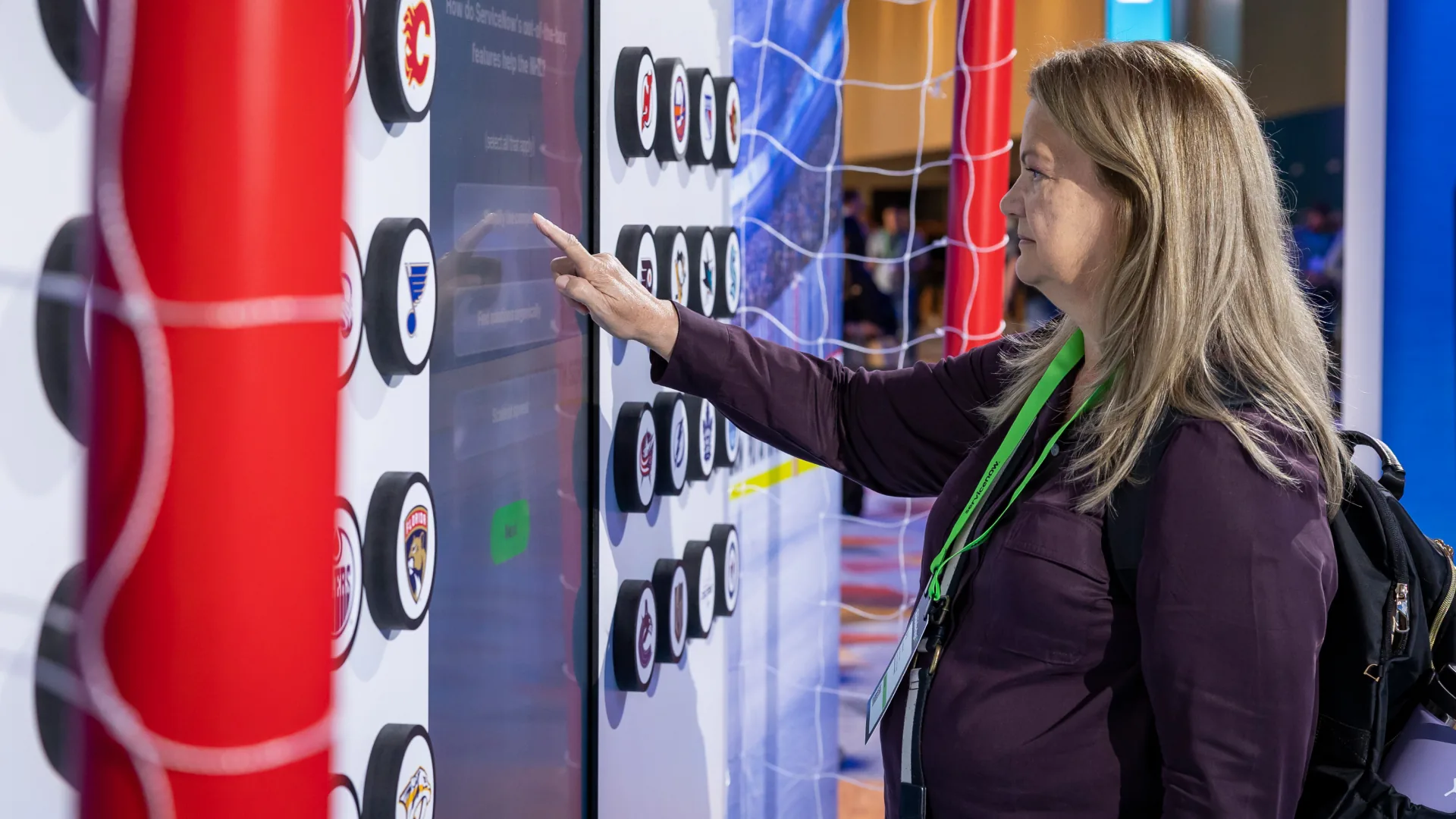
Approach. Getting people to step up is the first hurdle at an event, and physical interfaces clear it. At the Museum of Science in Boston, researchers built Robot Park, an exhibit for programming a robot in two versions, one with a mouse and screen and one with physical blocks. The block version drew more visitors and more group participation.⁸ In a separate study from Reichman University, 62.1% of 58 participants chose the tangible version and 34.5% chose the screen when offered both.⁹ Notice what these results do and don’t show. People choose physical interfaces and join in. They don’t necessarily learn more. That is still the job of an installation: to get people through the door.
Ownership. Touch changes how people relate to objects. Peck and Shu found that touching an object increases how much people feel they own it.¹⁰ In Harvard research on the “IKEA effect,” people were willing to pay about 63% more for a storage box they had assembled themselves than for a preassembled one, though the effect faded when they didn’t get to finish the build or had to take it apart.¹¹
Flow and affordance. When an experience feels like a game, people lose track of time. That takes a clear goal, instant feedback, and a challenge matched to the person’s skill, neither too hard nor too long. And when an object clearly invites use, visitors don’t have to guess what to do, which leaves more of their attention for the story.
There is a caveat, and it matters. Physical interaction is not magic on its own. People can remember the thing they touched better than the message it was meant to carry. The interaction has to be the idea, not decoration. In short: doing beats reading, hands help us think, and a clear physical interface lets the message be the focus.
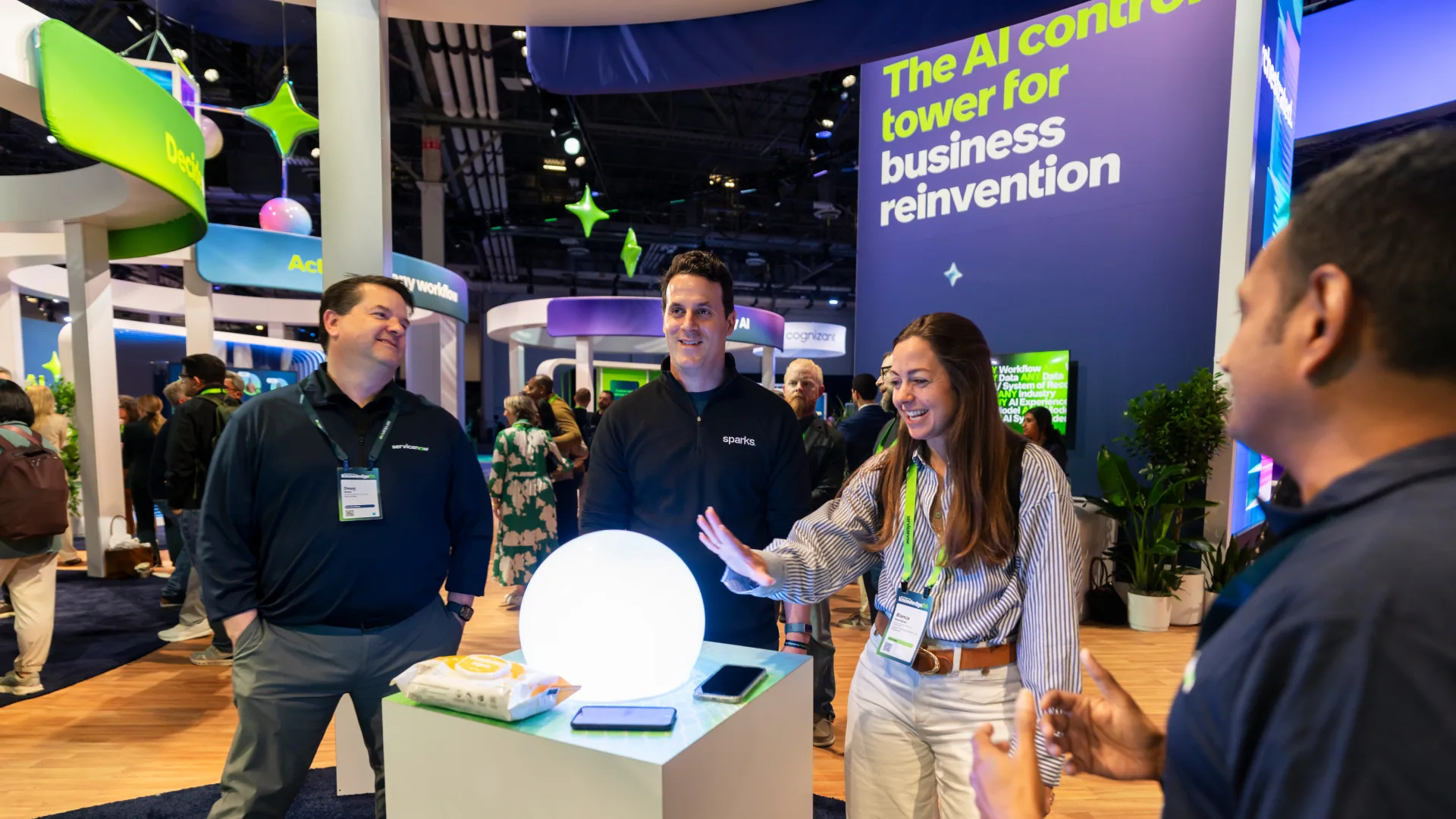
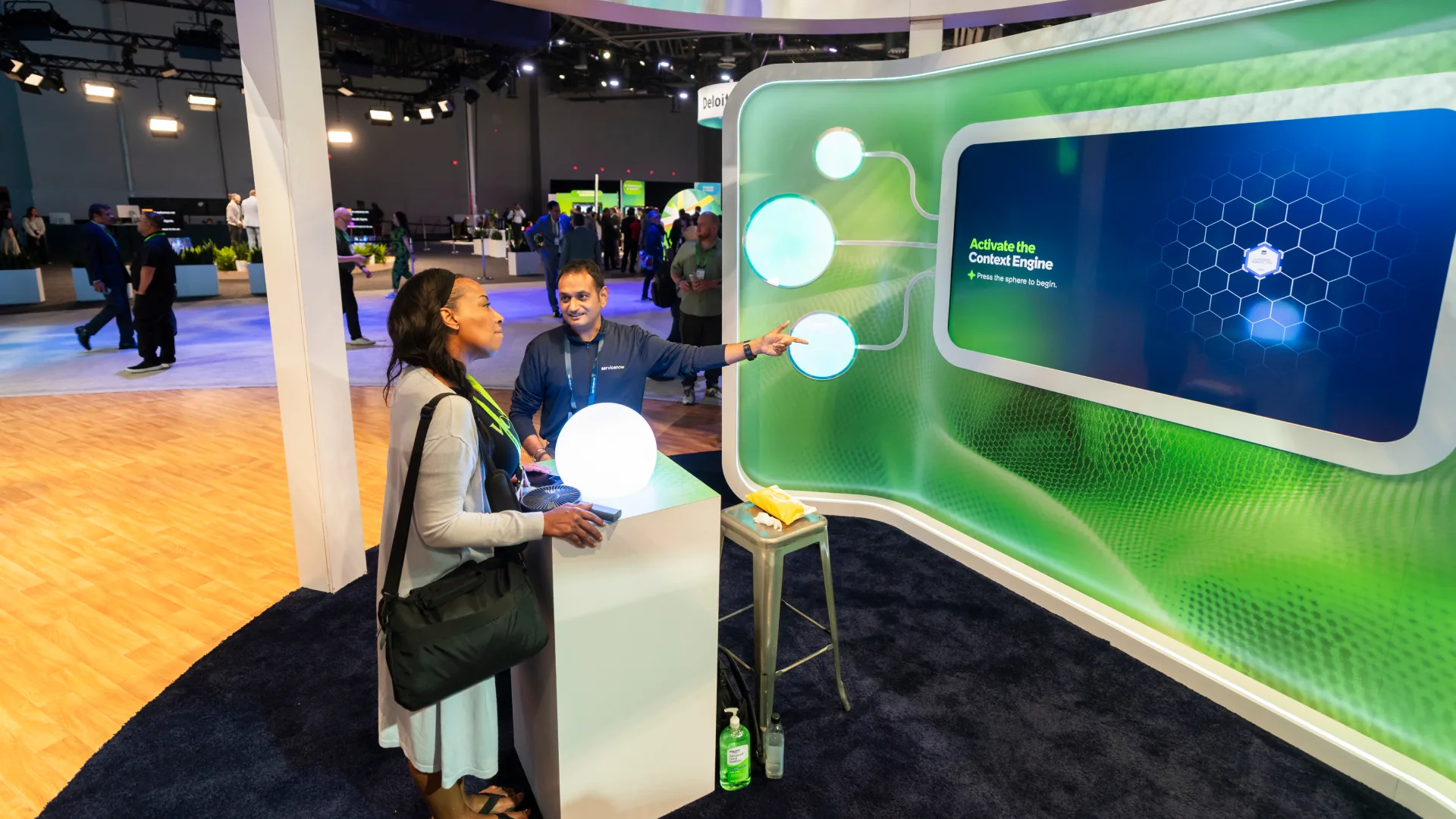
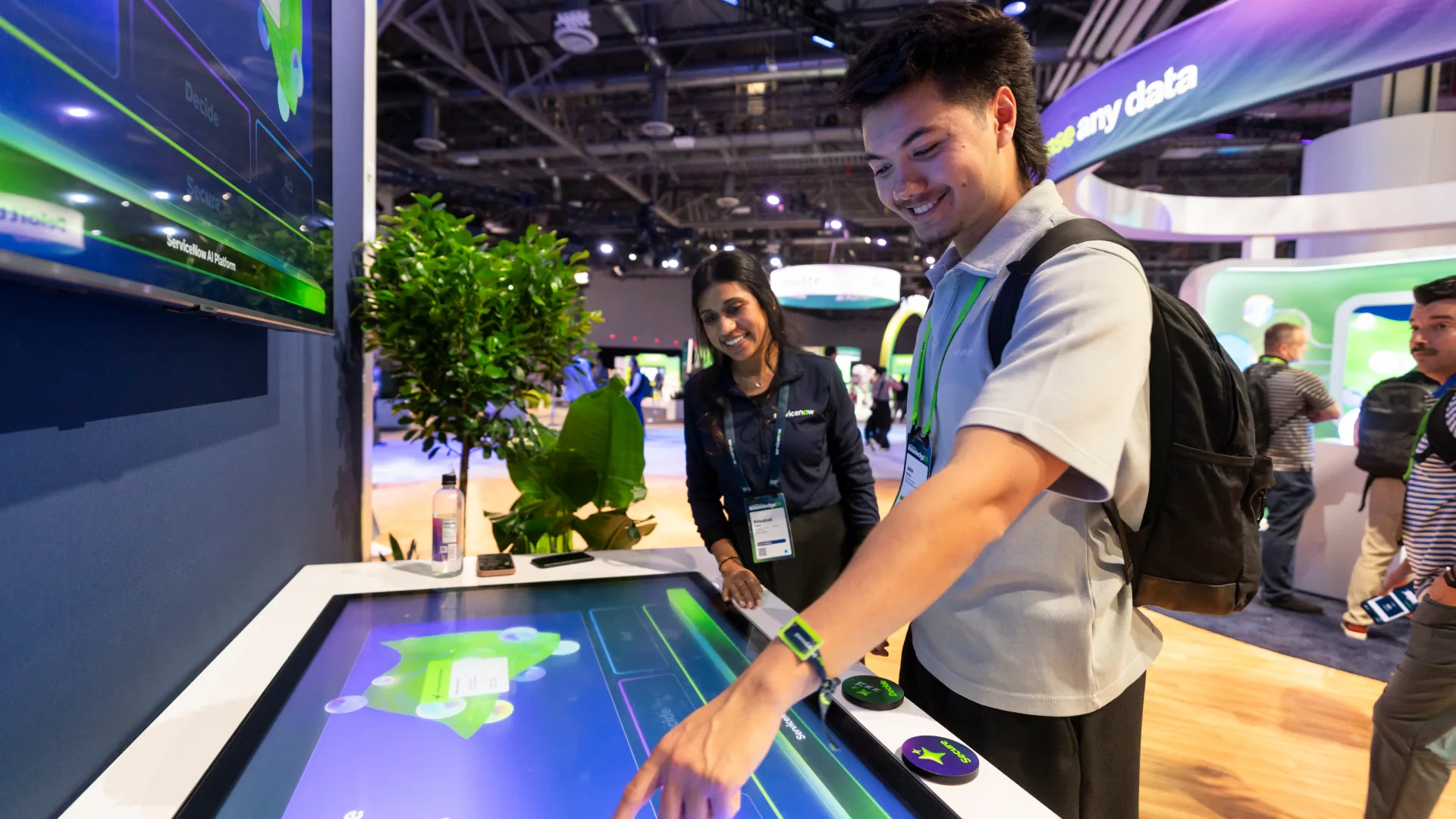
ServiceNow Knowledge 2026
The physical mechanism is the handshake
On our team, we think of the physical mechanism as the handshake: the moment a visitor meets a digital experience, where both the type of input and its emotional weight matter. There is no single right answer, but across our projects the mechanisms tend to fall into three families.
Immersive momentum. Wheels, sliders and cranks suit ideas about scale: scrubbing through a timeline, moving through a large data set, or explaining something bigger than one screen can hold. When someone is moving their arms, the idea feels big.
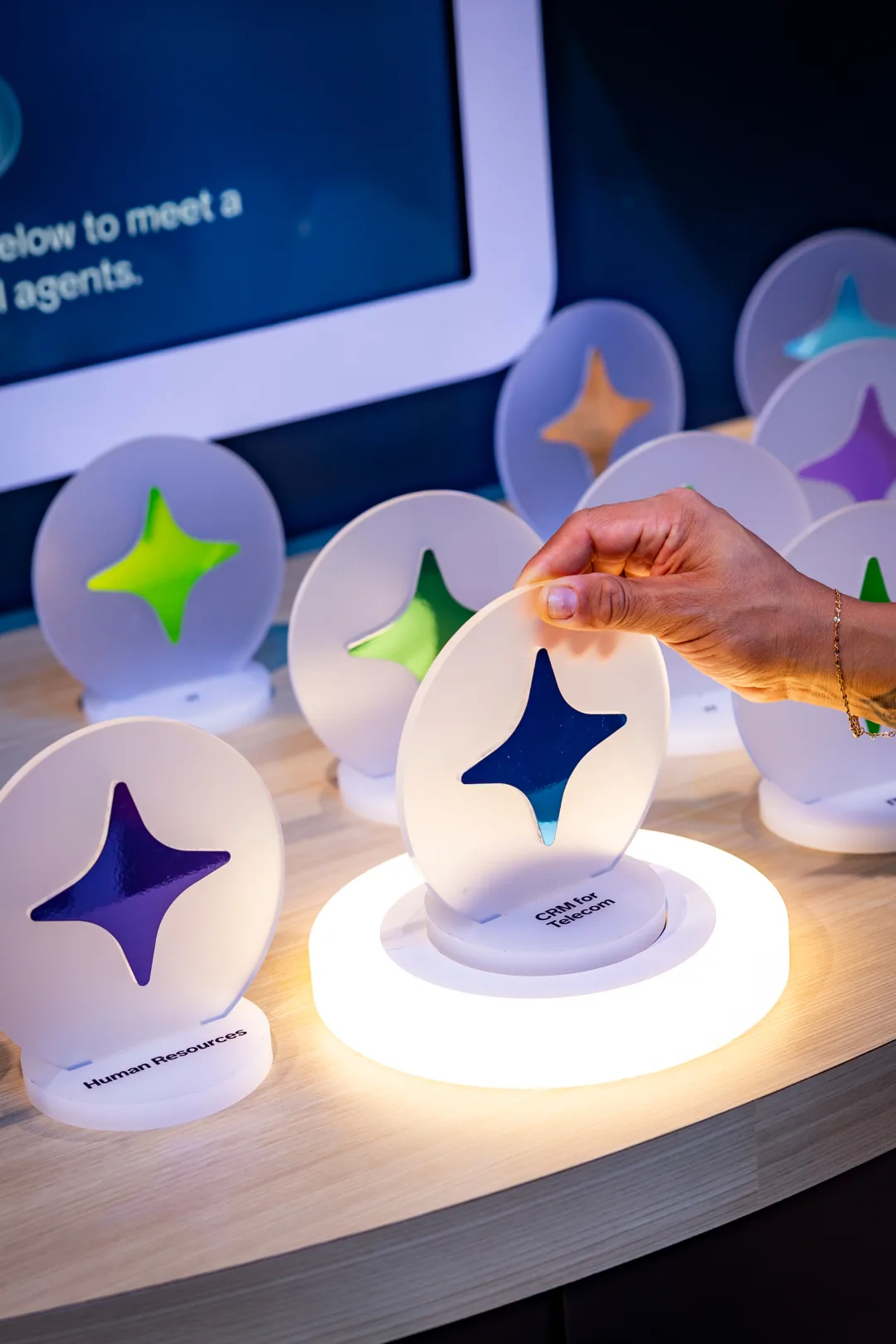
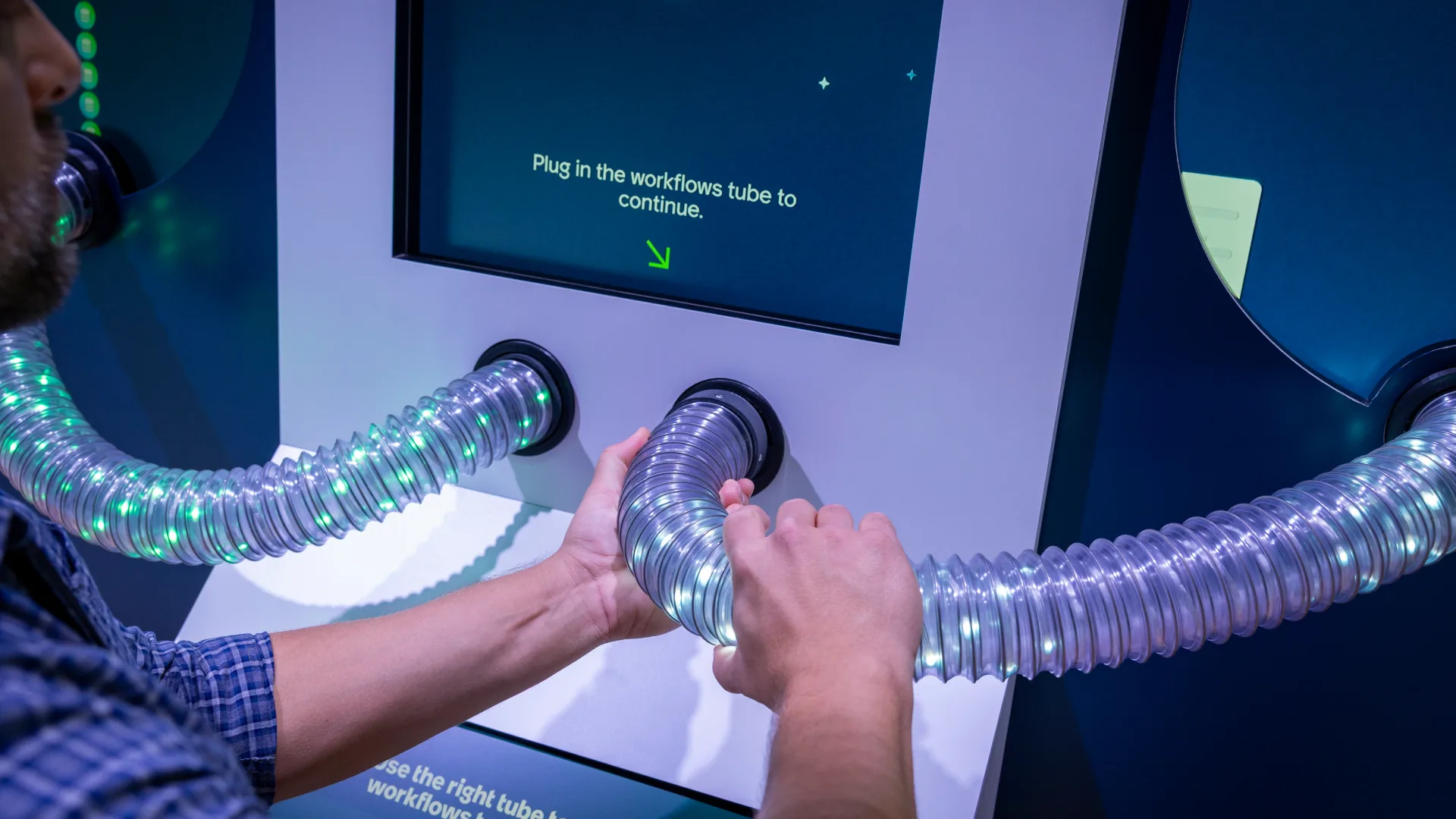
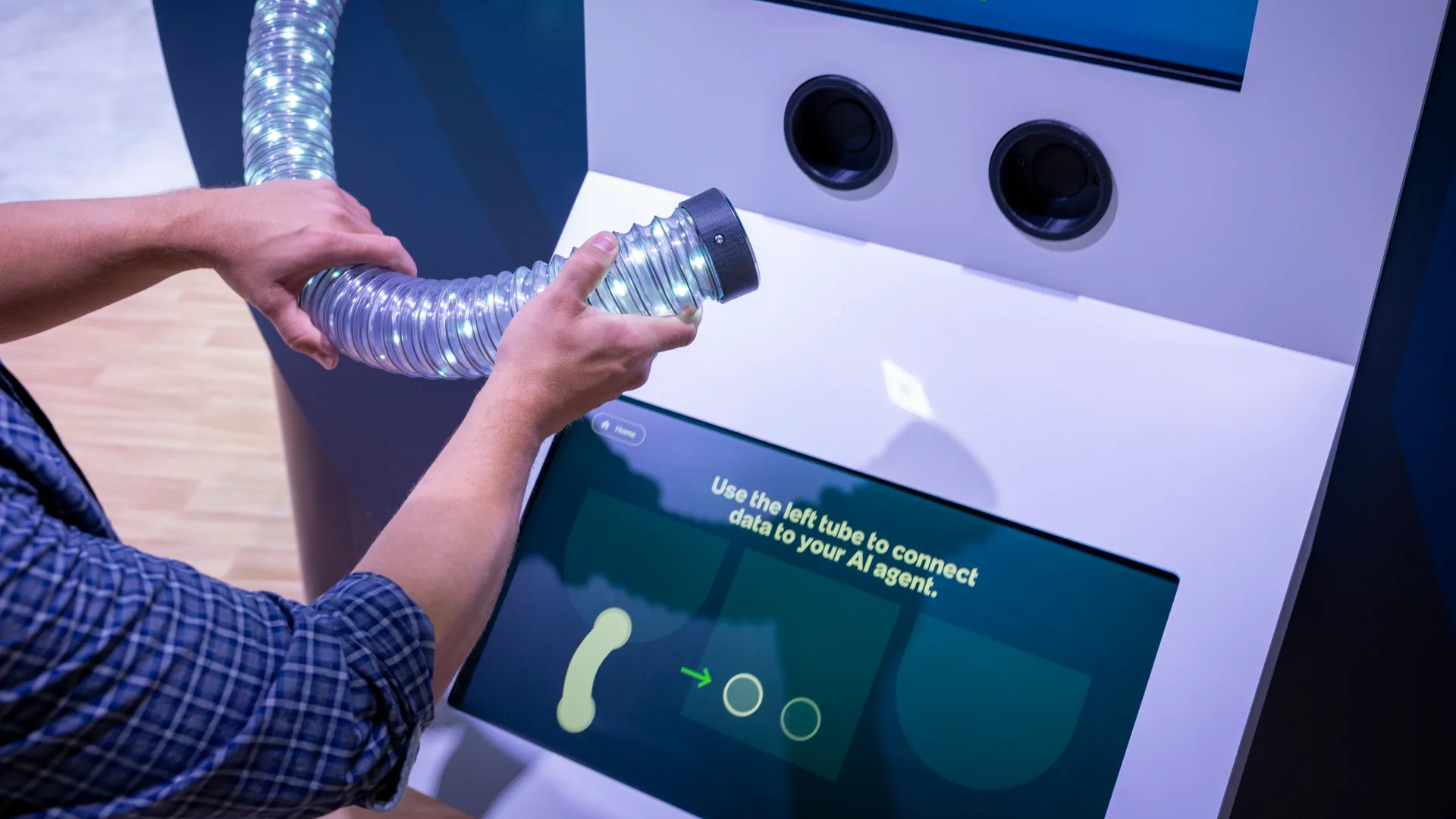
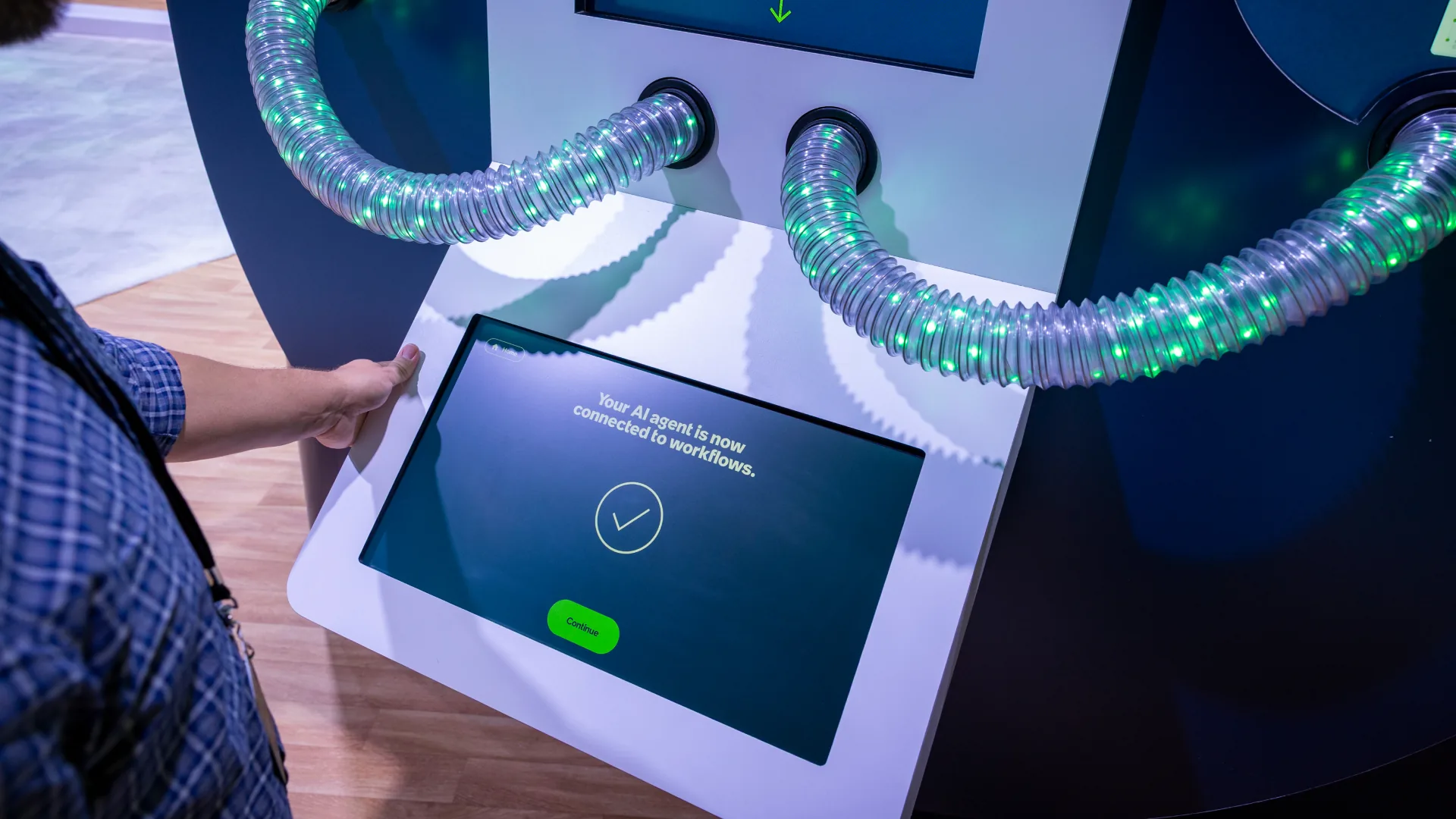
Decisive action. Buttons, switches and plugs. A choice on a touchscreen can feel temporary or easy to undo, while pressing a button or plugging something in makes the choice feel made. At ServiceNow’s Knowledge 25, we built a lit tube that visitors grab and plug in. It snaps into place, the light and animation change, and the installation shows what happens when you connect a data source to an AI workflow. An abstract concept becomes something to do, with an immediate result.
Invisible magic. Here the environment itself responds. Elements move, or sensors in the space pick up a visitor’s presence and change the surroundings. In our work for Netflix FYSEE, an installation themed to Wednesday rotates a sculpture when a visitor snaps twice over a book.
Many projects span more than one family, and the best often combine them. The more important discipline is the order of operations: start with the message, then find the mechanic that serves it. Too many briefs start from the end result, such as “we want a game” or “we want a touchscreen,” and the first job becomes going back to ask what the client is really trying to communicate.
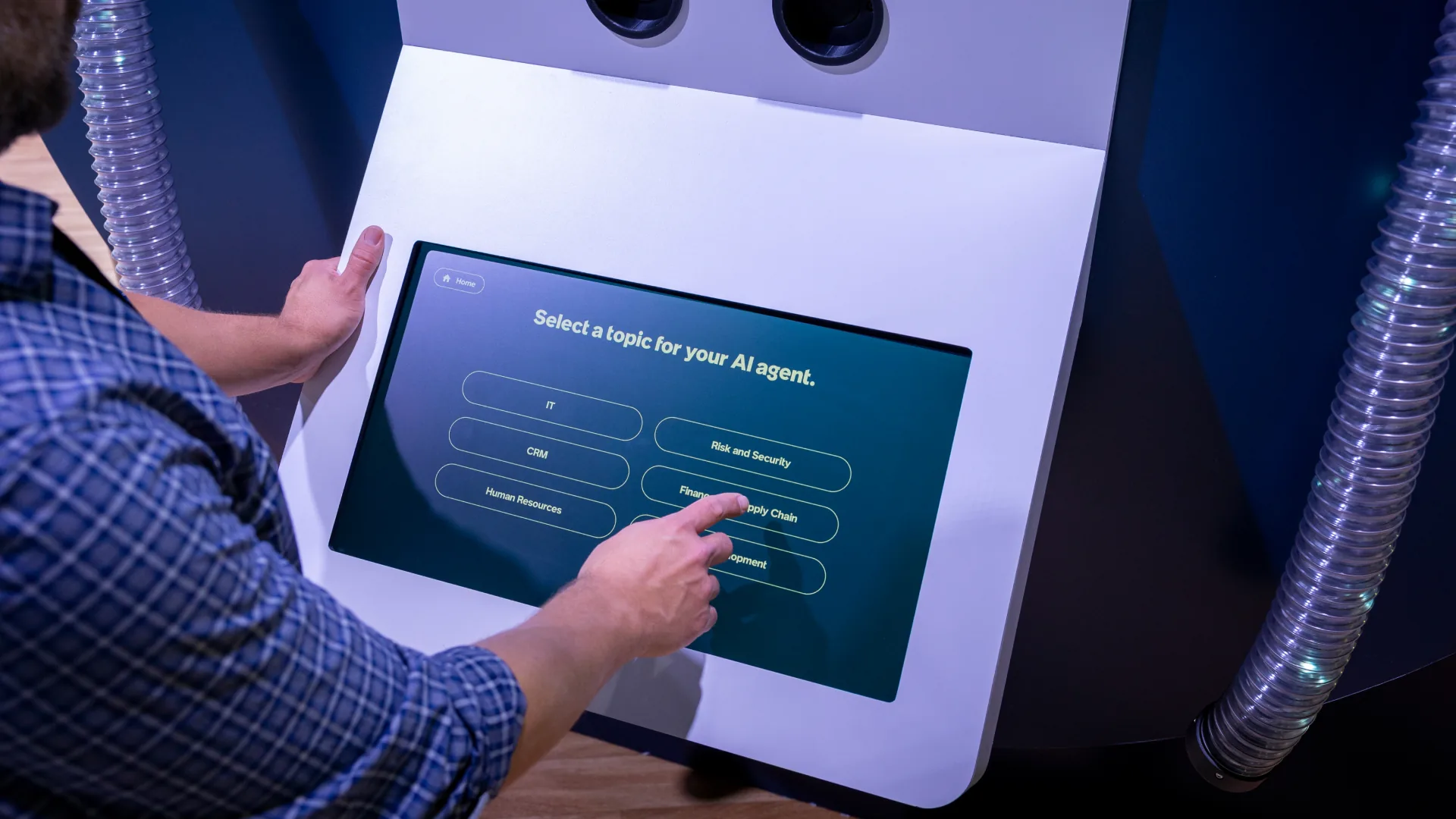
ServiceNow Knowledge 2025
In practice at ServiceNow Knowledge 2026
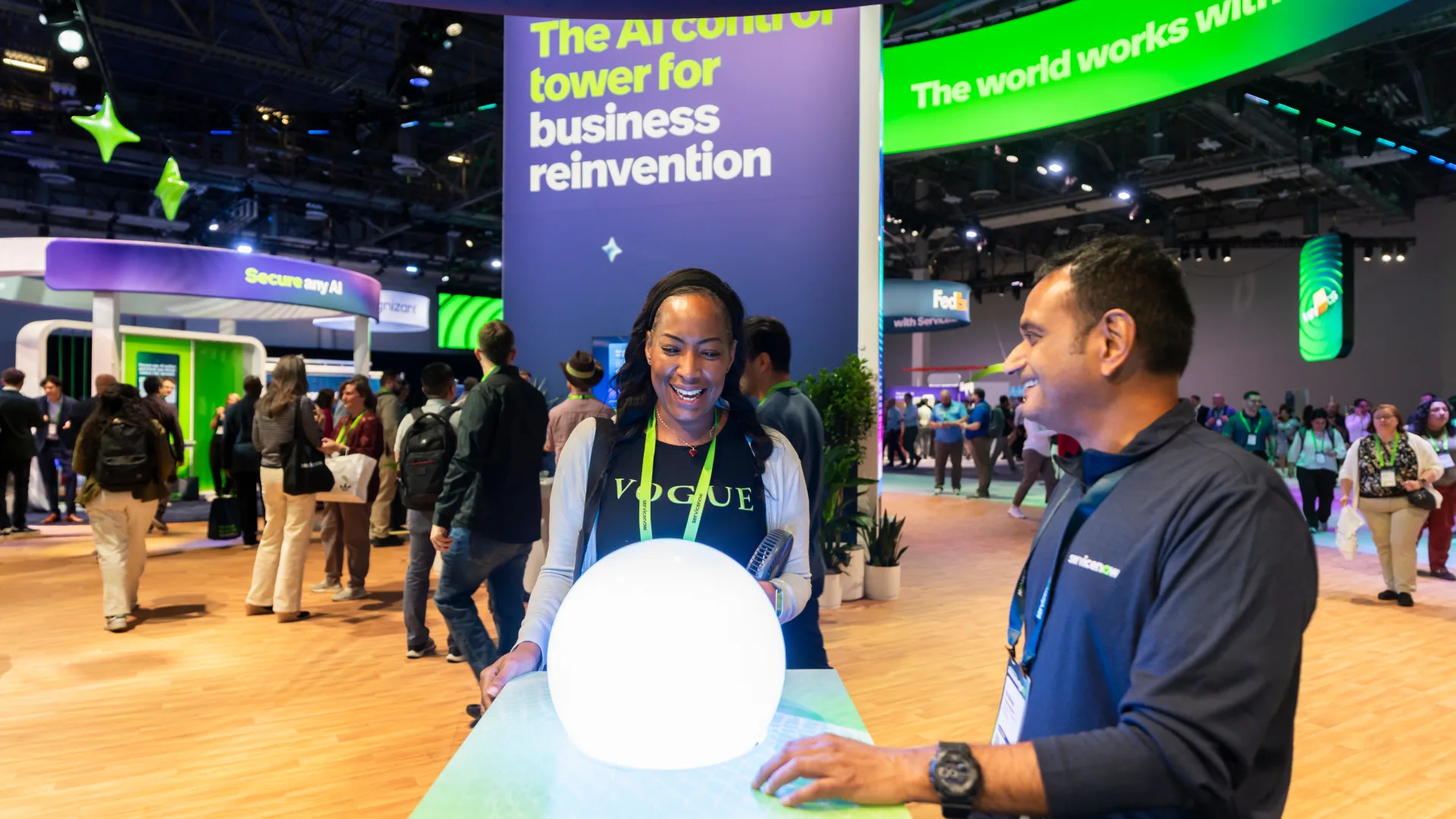
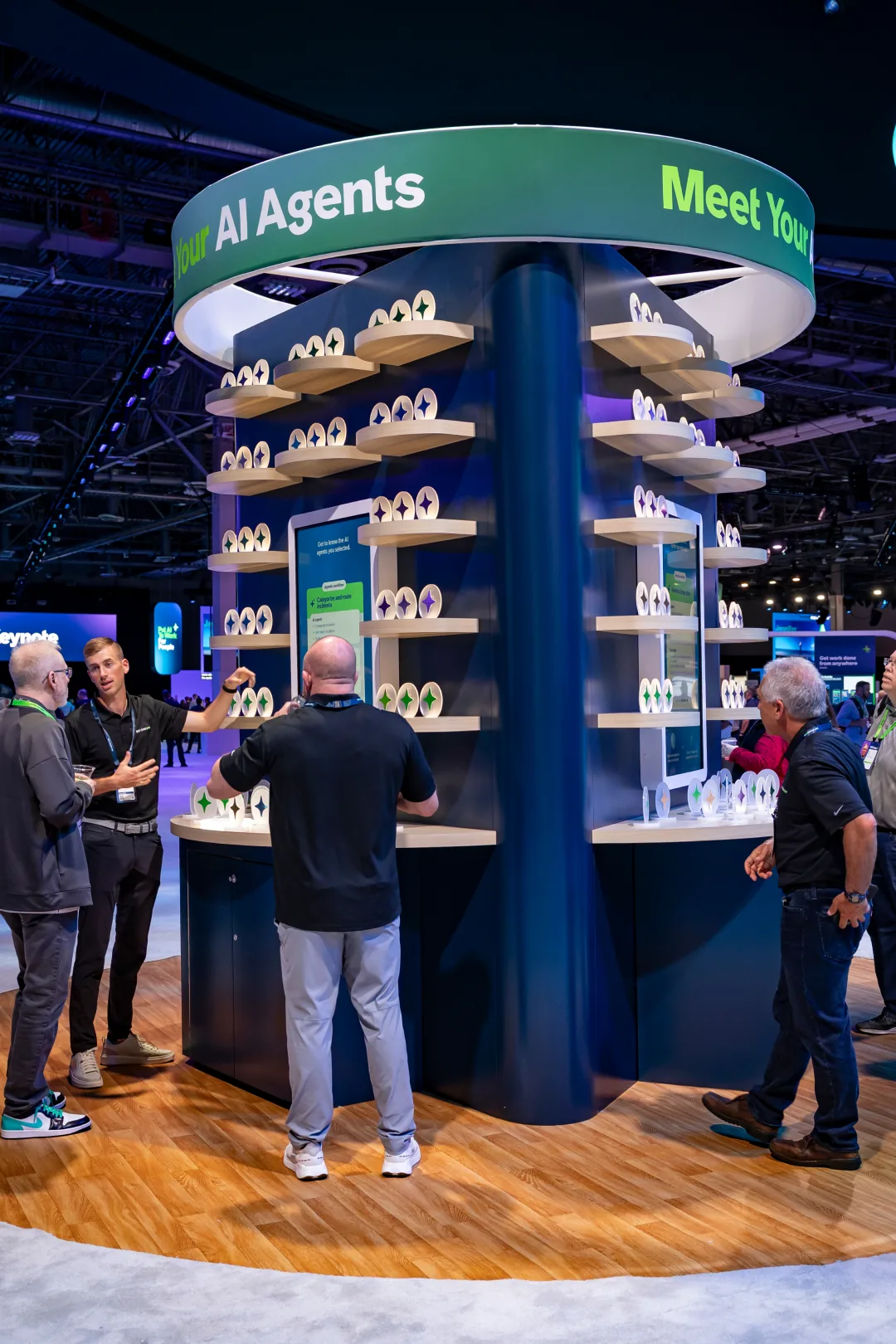
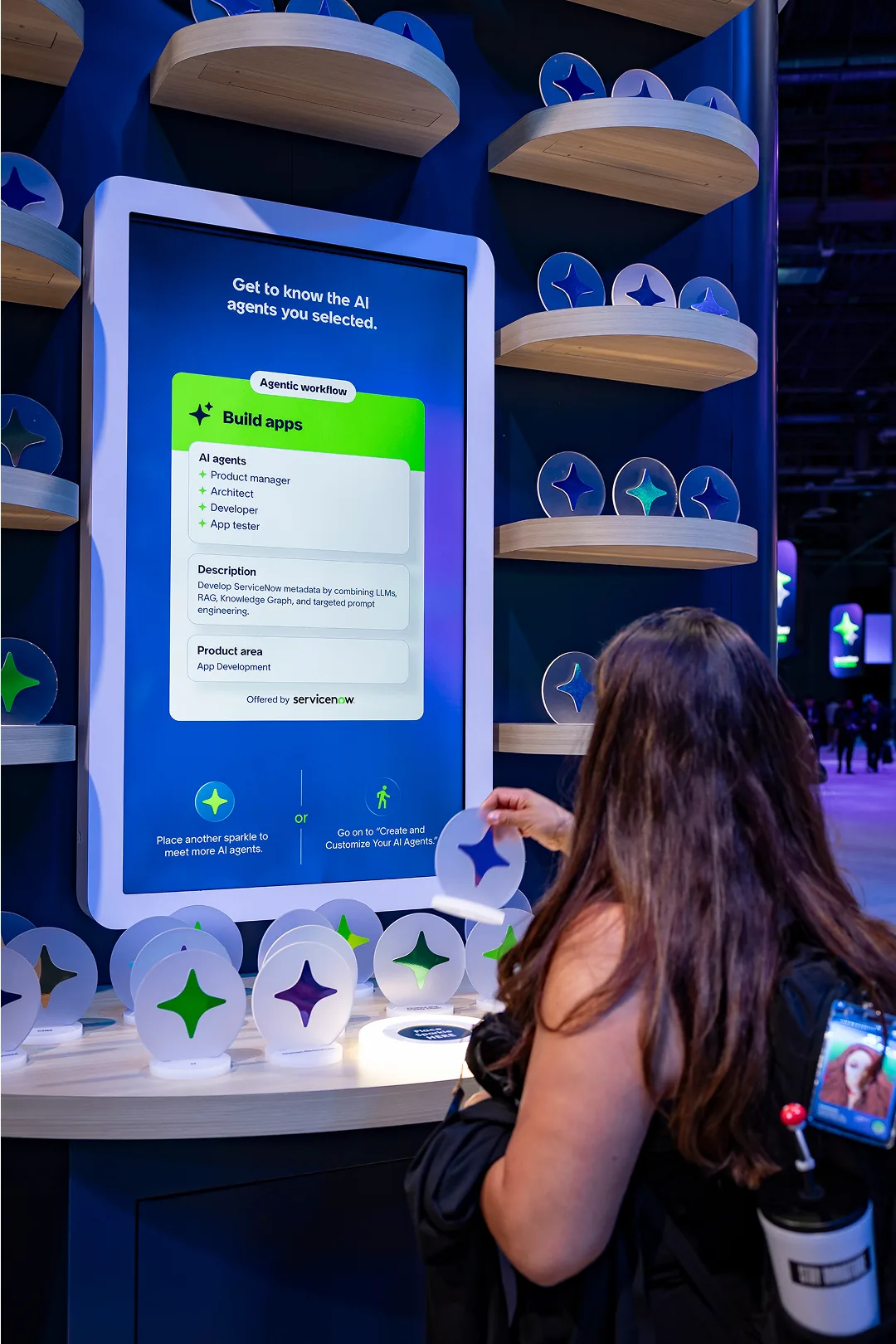
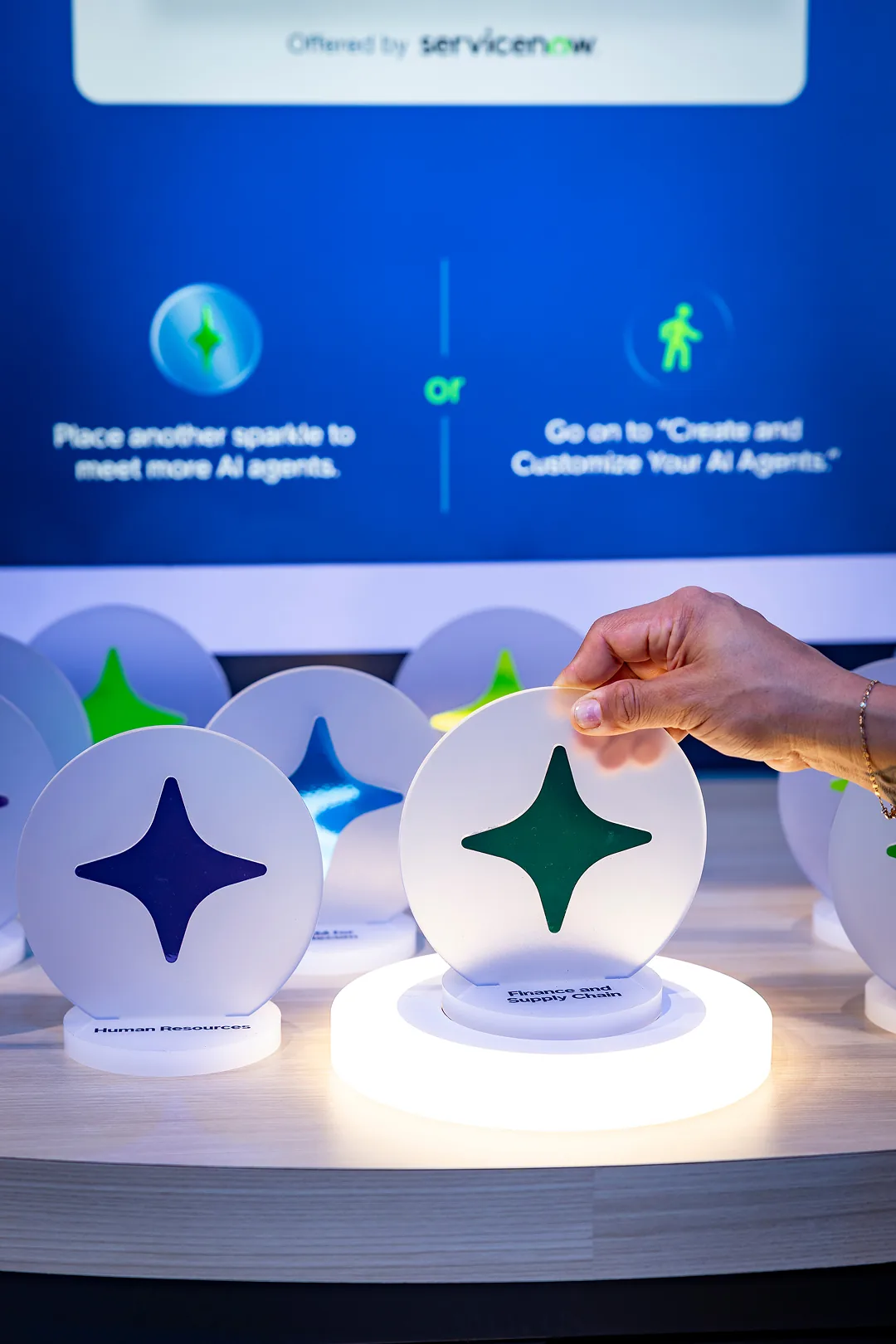
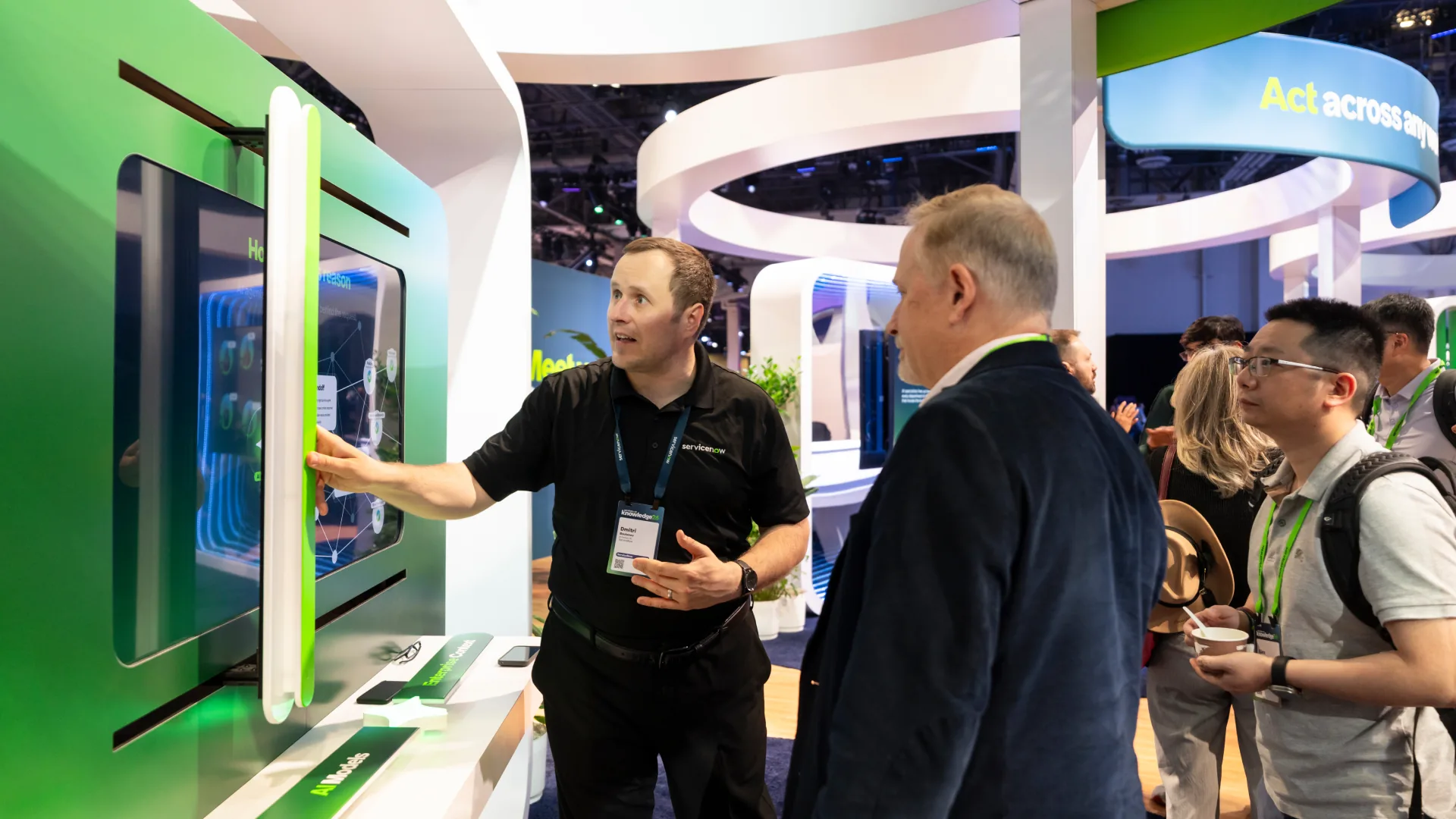
In early conversations about ServiceNow’s agentic AI platform, the client kept describing orchestration that happens behind the scenes, which users never need to see because the interface stays clean. But attendees needed to understand that all the connected data sits inside a governed, secure system. Our team landed on a slider, like the before-and-after photo scrubbers on websites, but at human scale. Moving it reveals what’s under the hood, literally under your hand. Everyone already knows how a slider works, which is affordance doing its job.
ServiceNow Knowledge 2026
From idea to installation
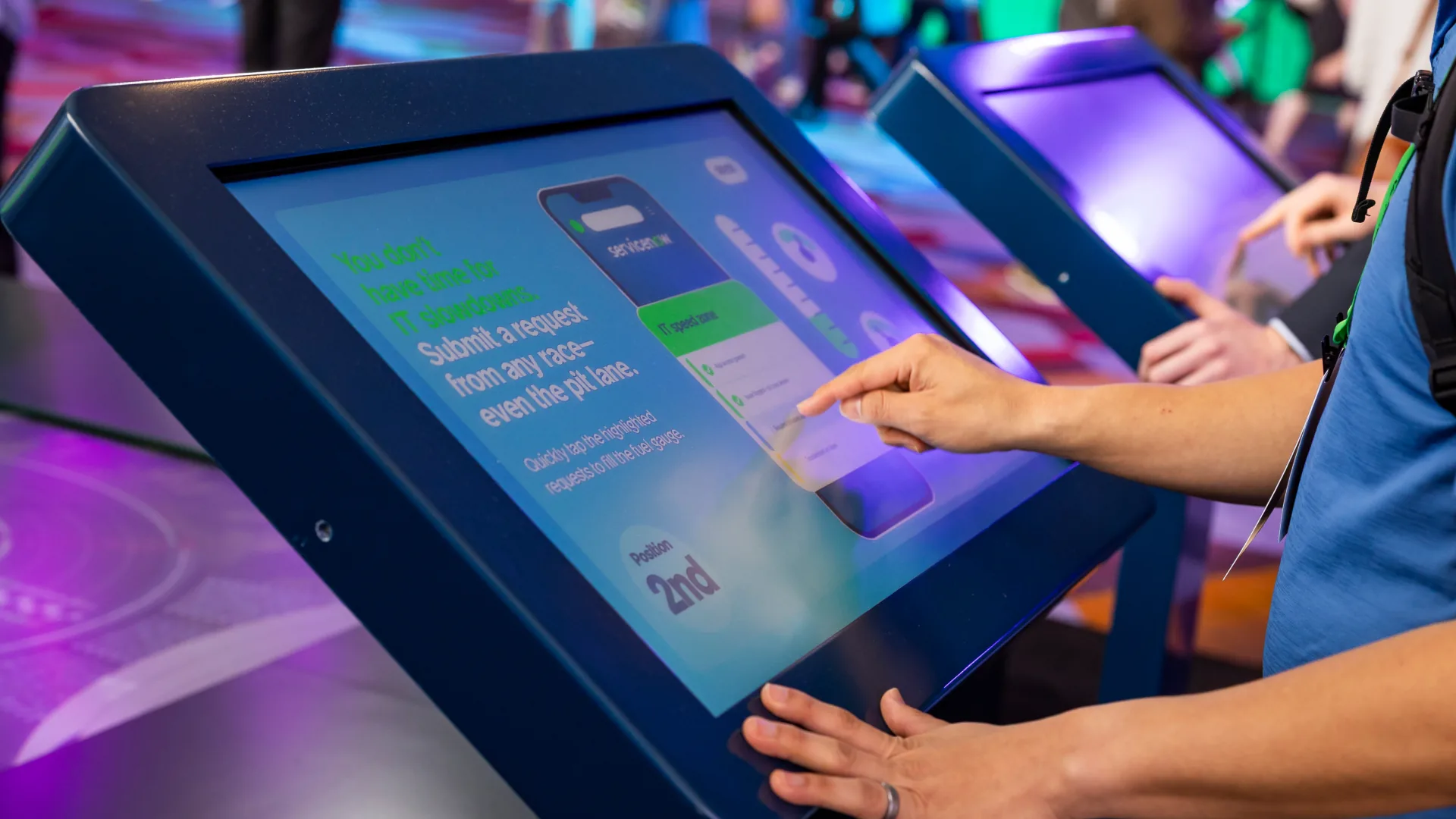
An idea like the slider is only the start. Making the interaction feel right is an engineering and fabrication problem. We look for the sensor that gives the most instant feedback, with no lag, so the installation feels responsive. We work out how it fits into the structure, design the control mechanism, and develop control drawings with the fabrication team. Then it goes into shop testing, where we document how it performs and refine the interface round by round.
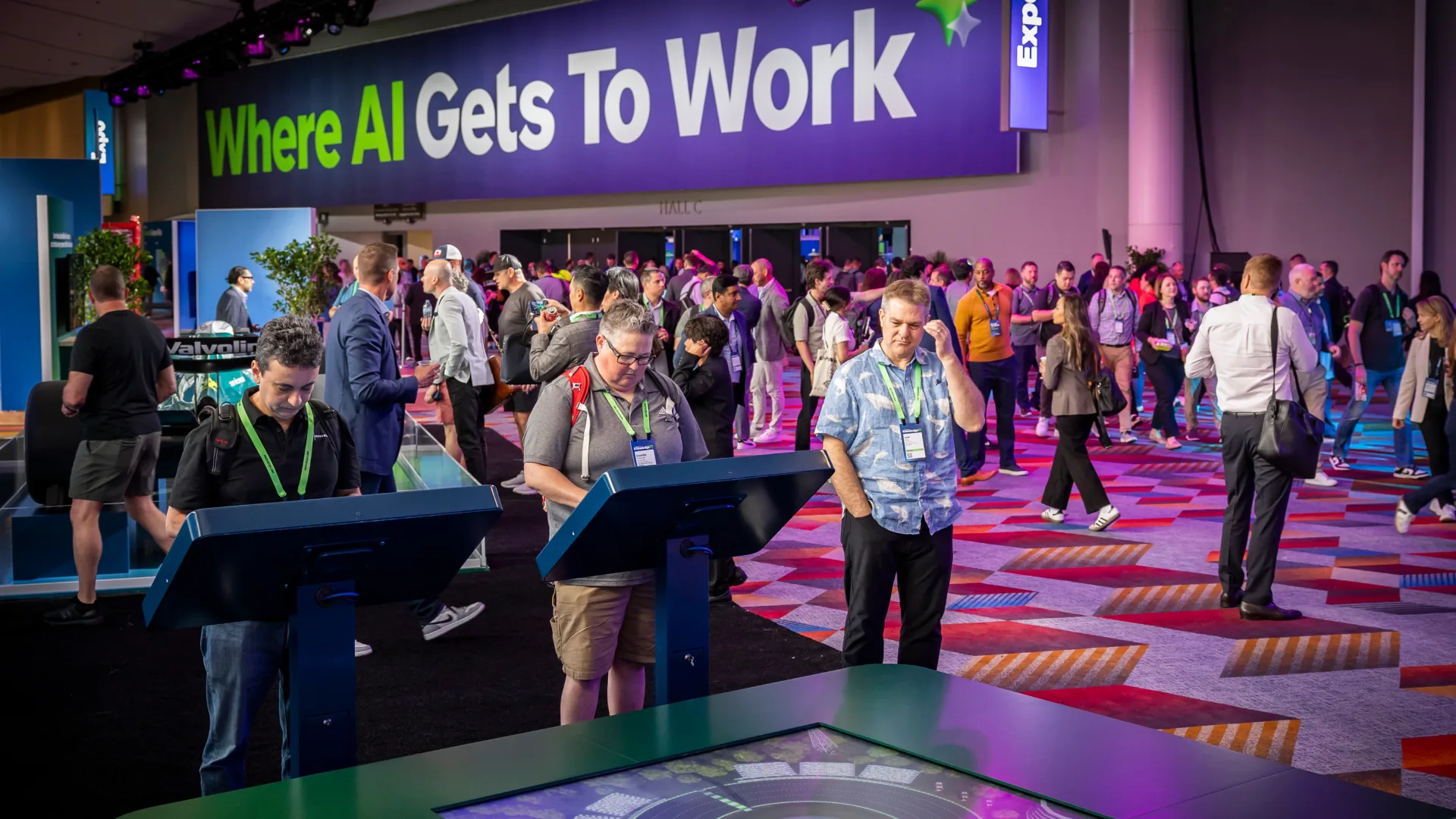
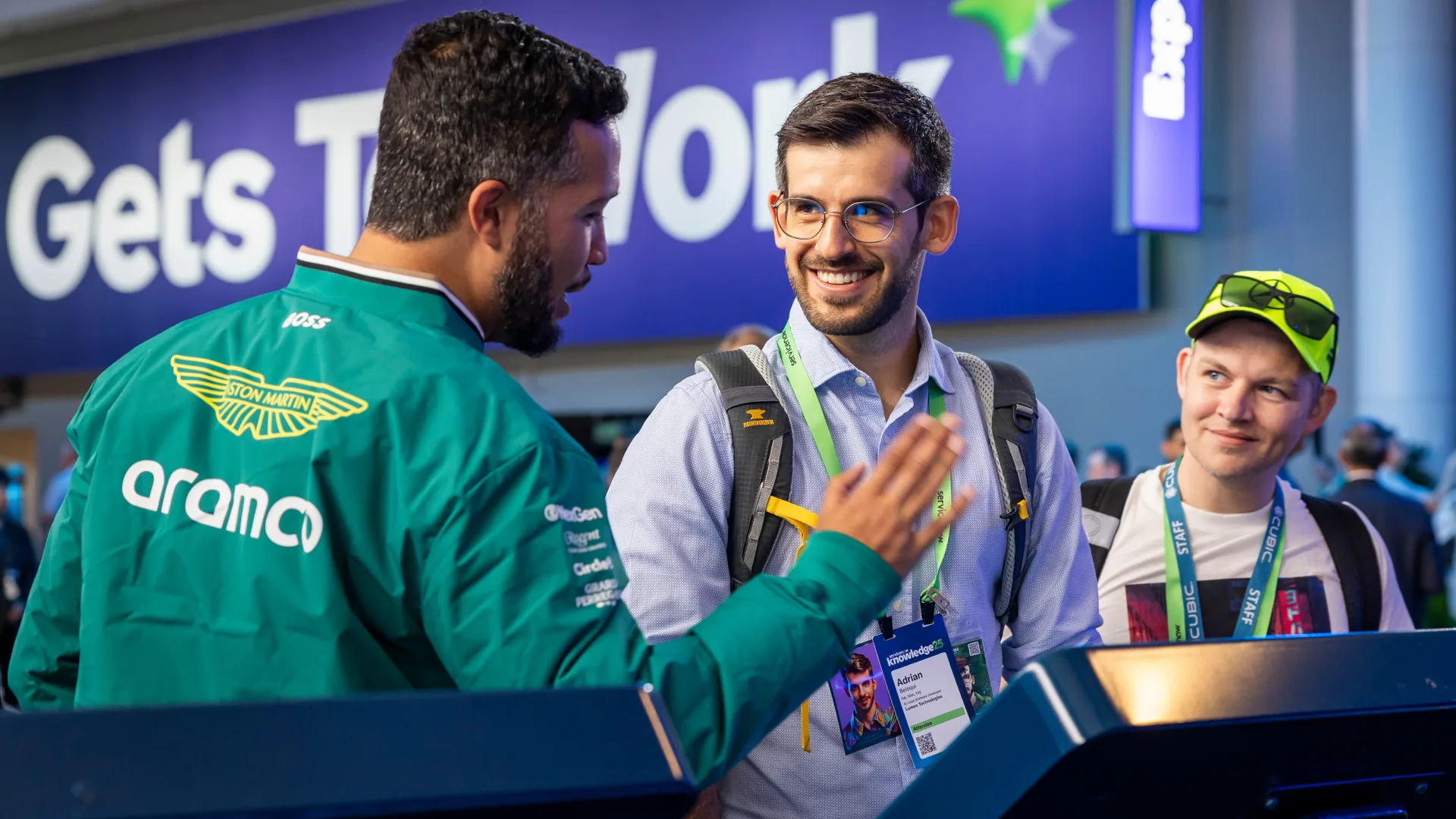
The goal is that by the time hundreds of people are using it on site, every detail has been thought through: the tuning, the tension, the materiality of the handle. And because live events are full of distractions, we don’t leave installations unattended and hope people engage. We staff our activations so someone is on hand to help visitors get started, and it makes a big difference.
ServiceNow Knowledge 2025
Five design principles for the tactile advantage
- Find the metaphor. Listen closely, whether to the product team’s download or to your client, for the idea that keeps repeating and will bring the message to life. That leads you to the object you’ll build.
- Design for affordance. It has to look usable and draw people in. Test it on people who haven’t used it before.
- Design for groups. Make it social. When more people can interact at once, you get more throughput and more interaction.
- Make it feel good. It should respond immediately, and people should know how to use it.
- Measure understanding. Many teams track only badge scans or how many people went through. Ask people at the end whether they understand the concept better than when they arrived. Measurement is a discipline we take seriously at Sparks: for Xbox at Gamescom 2025, we quantified the return on the activation at 11x.
Be clear about what you want people to remember, then give them something to hold onto.
Frequently Asked Questions
The tactile advantage is the edge physical interaction gives live events when screens and generated content are everywhere. People arrive with little attention to spare and a growing doubt about what is real. A physical object to touch, turn or plug in gets them to approach, helps them remember, and makes an abstract idea concrete.
Research points to three effects. People choose physical interfaces and join in, as at the Robot Park exhibit and in the Reichman University study.⁸ ⁹ They remember actions they perform better than things they only hear or read.⁶ And touching or building something raises their sense of ownership.¹⁰ ¹¹ The research doesn’t show that people necessarily learn more from physical versions, so the interaction has to carry the message.
We group them into three families. Immersive momentum (wheels, sliders, cranks) suits ideas about scale. Decisive action (buttons, switches, plugs) makes a choice feel made. Invisible magic (sensors and a responsive environment) lets the space react to the visitor. Many projects combine them, and the right mechanism comes from starting with the message.
Go beyond badge scans and throughput. Ask people at the end whether they understand the concept better than when they arrived. Sparks also quantifies the return on activations: for Xbox at Gamescom 2025, we measured 11x.
Creative technology is the design and engineering of interactive experiences that connect physical environments, technology, and digital content, so an idea becomes something visitors can touch and use. At Sparks, the work runs from finding the story and choosing the mechanism of interaction, through design development, hardware design, fabrication shop testing to on-site deployment.
Yes. Creative technology is a Sparks service. The team has designed and built tangible-interface installations for brands including Netflix and ServiceNow. To start a conversation about an upcoming event, contact Sparks.
Creative Technology at Sparks
Sparks is an experiential marketing agency that designs and produces brand experiences for live events. Creative technology is one of its services: Sparks’ creative technology team designs and builds interactive and tangible-interface installations, from the initial concept and design development through hardware design, software development, fabrication and shop testing to on-site deployment. Recent work includes Netflix FYSEE, ServiceNow’s Knowledge conferences and Xbox at Gamescom 2025.
Planning an interactive experience for an upcoming event?
References
- Vinyl sales: Luminate and RIAA 2025 figures, Digital Music News (March 18, 2026)
- Spotify skip rate: “Quarter of Spotify tracks skipped in first five seconds,” Netimperative (2014)
- Microsoft, “New Microsoft study reveals the rise of the ‘infinite workday,’” Microsoft News (Switzerland), June 17, 2025, reporting the 2025 Work Trend Index.
- Gloria Mark on screen attention: “Can’t pay attention? You’re not alone,” University of California
- Gartner Marketing Survey Finds 50% of Consumers Prefer Brands That Avoid Using GenAI in Consumer-Facing Content (March 16, 2026)
- Roberts, B. R. T., MacLeod, C. M., & Fernandes, M. A. (2022). The enactment effect: A systematic review and meta-analysis of behavioral, neuroimaging, and patient studies. Psychological Bulletin, 148(5–6), 397–434. University of Waterloo copy
- Kirsh and Maglio, “On distinguishing epistemic from pragmatic action,” Cognitive Science (1994)
- Horn et al., “Comparing the use of tangible and graphical programming languages for informal science education,” CHI 2009; see also Tufts Robot Park project page
- Zuckerman & Gal-Oz, “To TUI or not to TUI,” Int. J. Human-Computer Studies 71 (2013)
- Peck and Shu, “The Effect of Mere Touch on Perceived Ownership,” Journal of Consumer Research 36(3), 2009
- Norton, Mochon and Ariely, “The IKEA Effect: When Labor Leads to Love,” Harvard Business School