The Opportunity
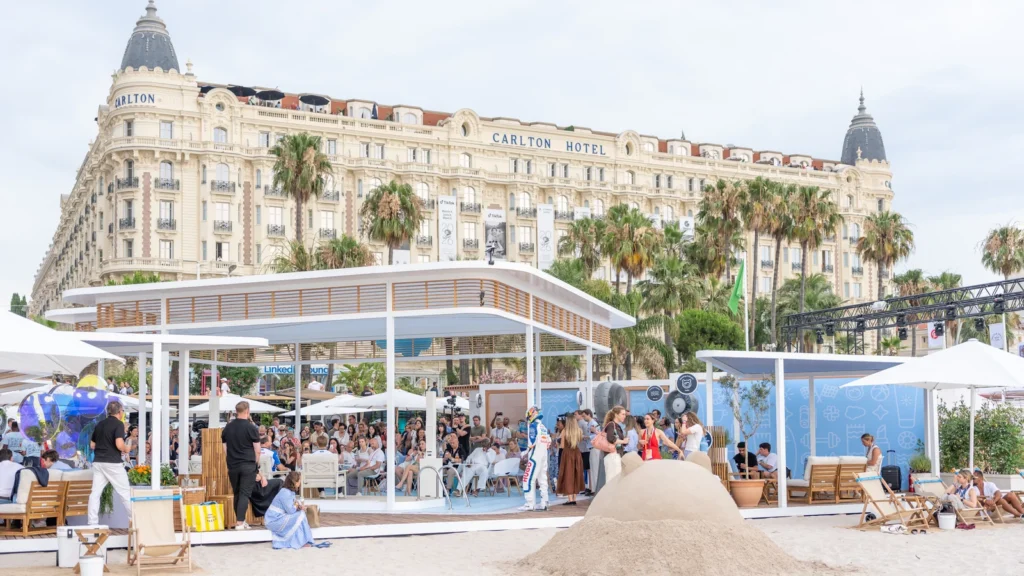
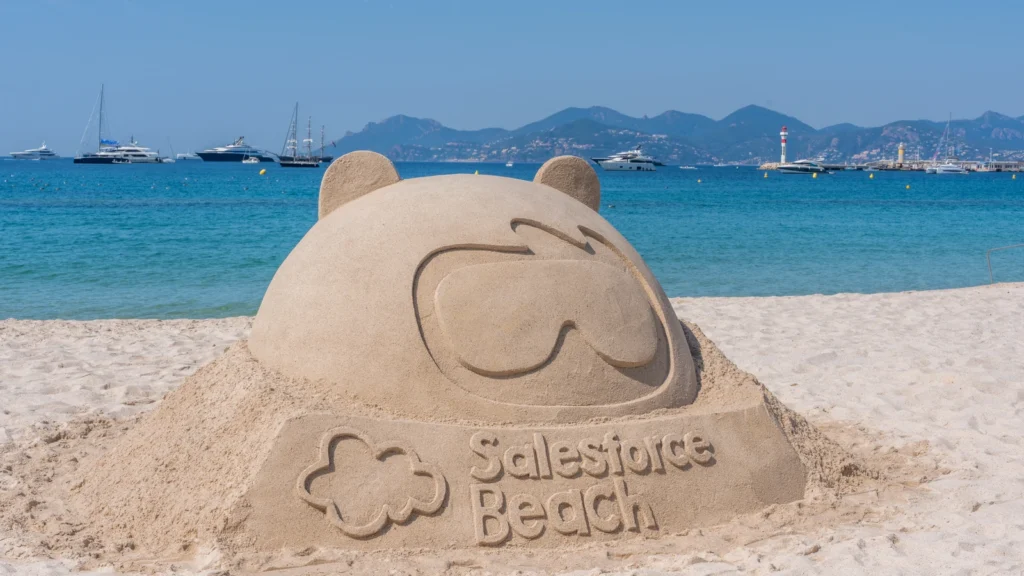
The marketing leaders who Salesforce most wants to reach spend the week along the Croisette at Cannes Lions, moving between countless appointments. Salesforce wanted a base in the middle of it, one that could host private client meetings, run a full agenda of panels and conversations, and welcome a steady stream of attendees. It was the first time Salesforce had opened an event to anyone who wanted to walk in, and it chose to use that wider audience to make its argument about creativity and AI.
A space built only for private meetings would feel closed to the crowd outside, and a space built only for foot traffic would have nowhere to take a chief marketing officer for a deeper conversation. Salesforce Beach would need to navigate both priorities at once, with a durable build, open from morning to evening for four days straight, on an exposed beach, changing shape to adapt to the brand’s evolving requirements.
Sparks’s role was to design and build that hybrid experience, and to run it so Salesforce’s team could spend the week engaging its guests instead of managing logistics.
The Solution
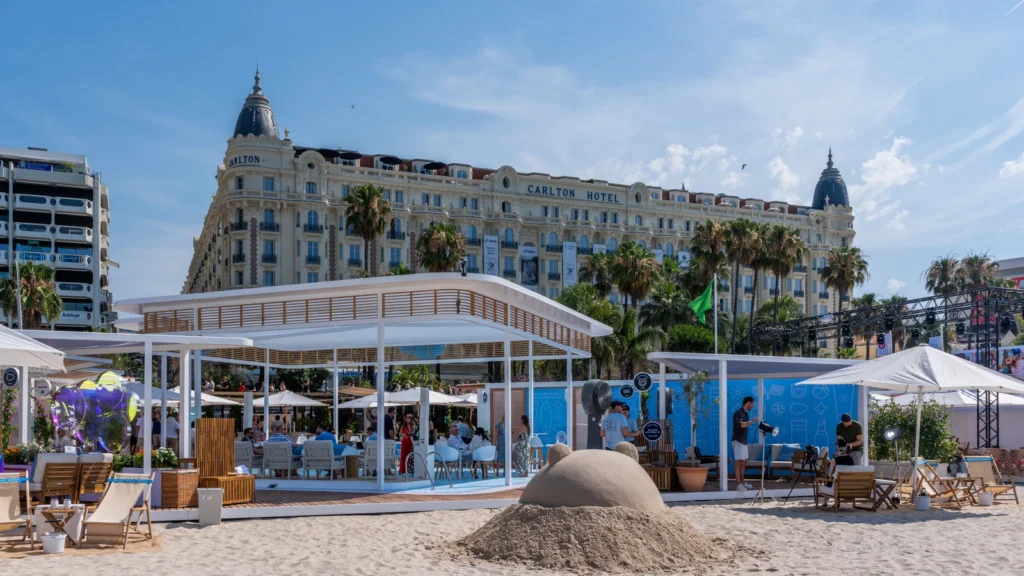
Sparks designed Salesforce Beach to change as attendees crossed it. From the boulevard down to the water, the space moved from open and public to private and considered, so a guest could arrive in the crowd and end up in a closed-door meeting without leaving the same world. That progression allowed one build to serve many purposes, set against an idyllic, relaxed setting that invited people to explore their own creative ideas.
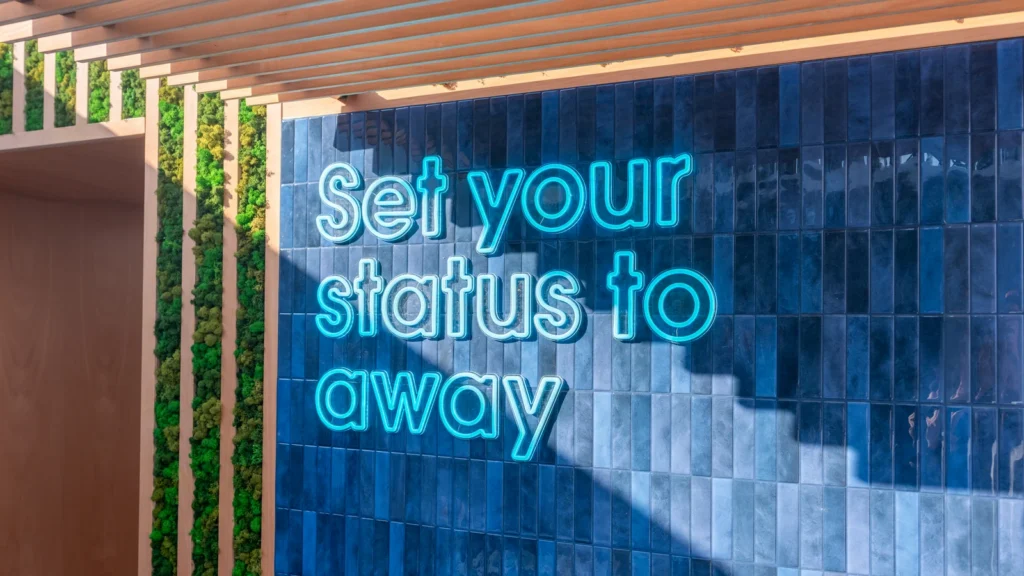
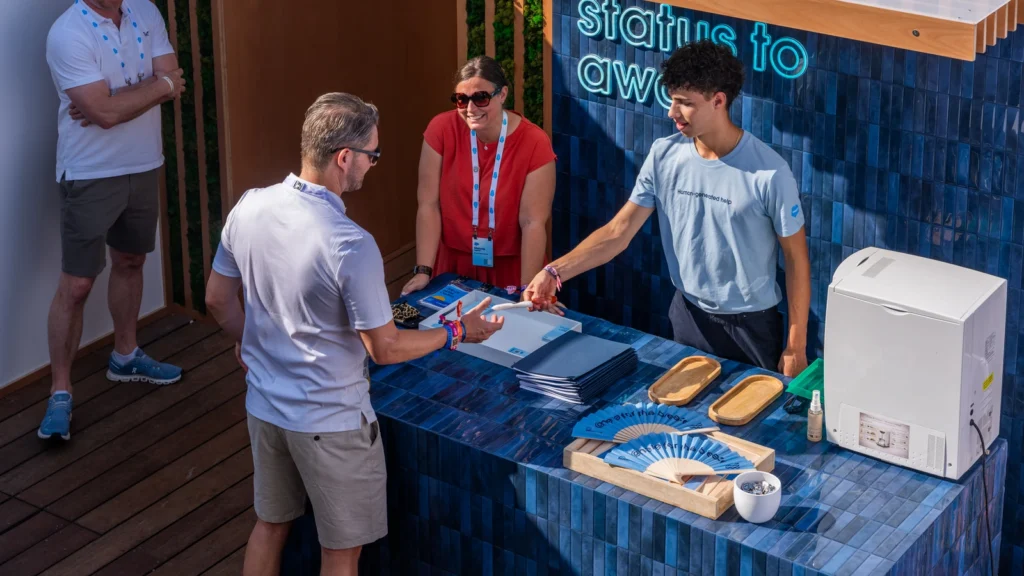
The experience began before guests stepped off the Croisette. A branded entrance, a Salesforce-blue kiosk, an Annex wayfinding tower, and a shaded queue, gave the destination a clear front door on a busy seafront. Inside, a landing foyer carried the brand’s voice from the first step, with the line “Set your status to away” written in neon above the check-in counter. A consistent and more subtle finish ran through the main floor and interior rooms, making a temporary build feel like a permanent one.
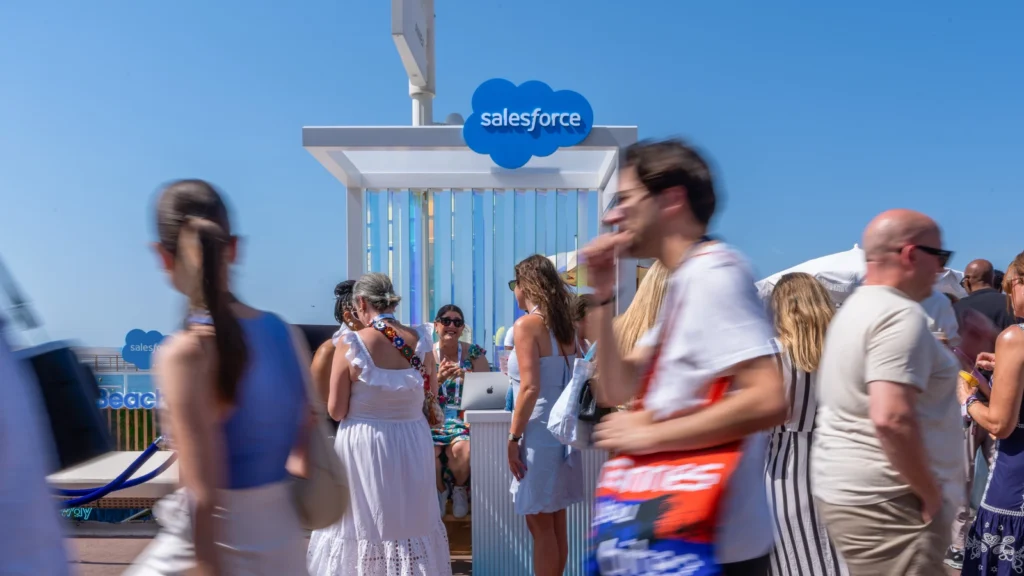
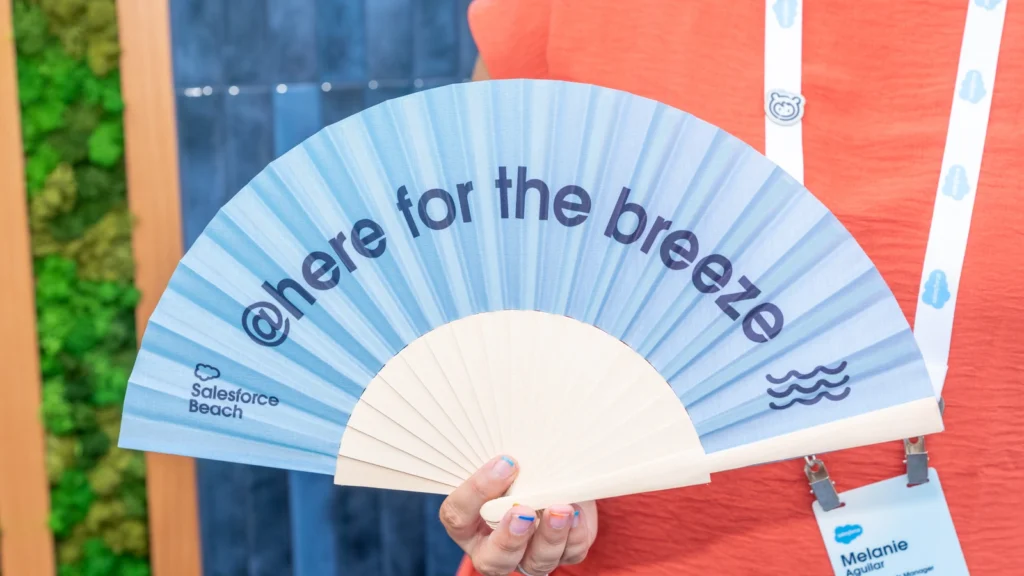
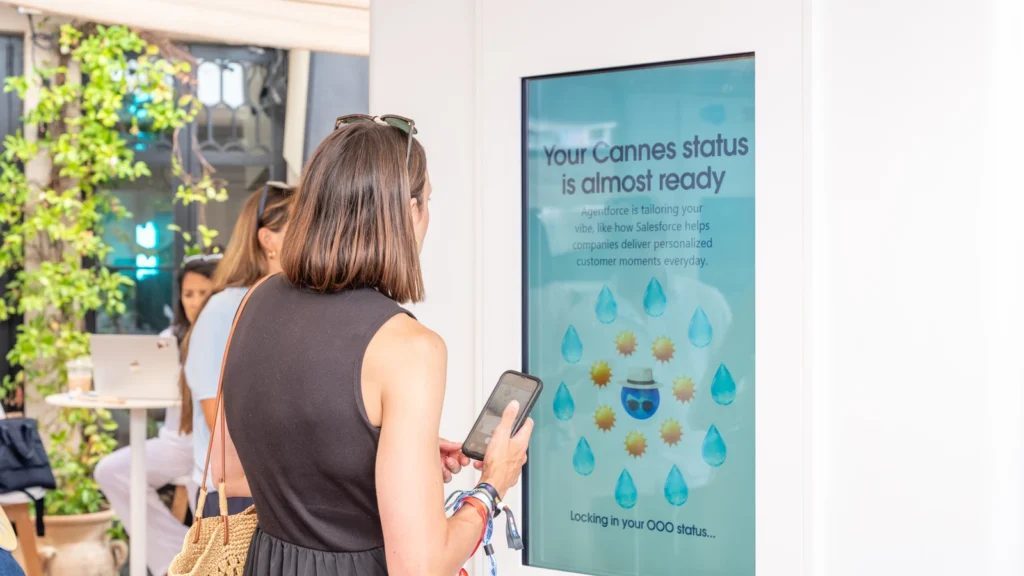
Salesforce sells something largely invisible: AI agents, data, automation, but an event like this is all about experiencing it first-hand. The activations were designed to give Salesforce’s products a form guests could touch and photograph, and to change the way guests saw the Salesforce brand.
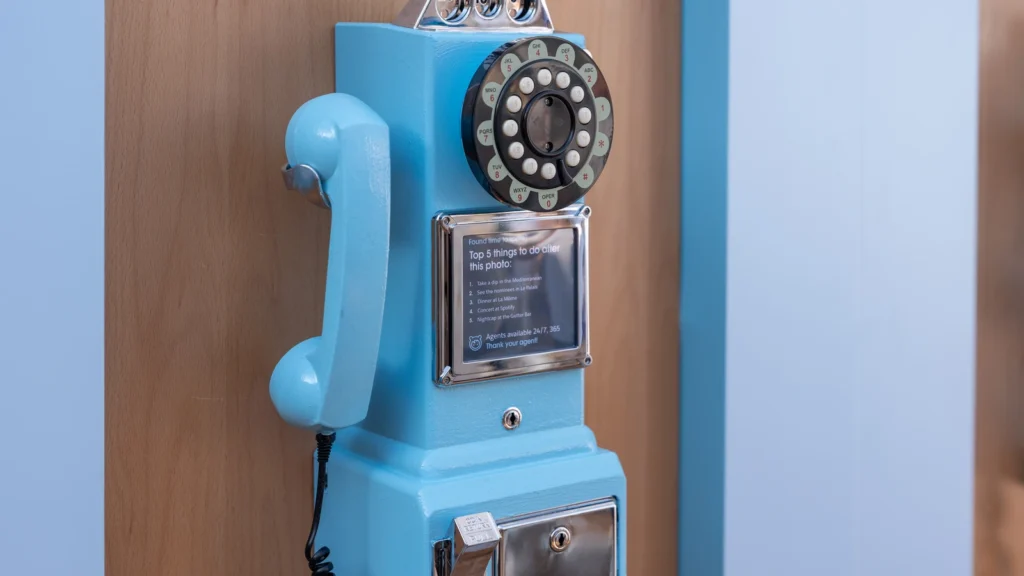
For example, Salesforce brought an F1 game called Track Star, built around its Formula 1 partnership, where guests could build a custom podium anthem and dance to it on headphones. A “Status Protection Formulator” turned a few questions into a personalized SPF result. And a “Talk to my agent” wall, lined with vintage payphones, gave guests a lighthearted introduction to their AI agent.
“For the ‘Talk to my agent’ activation,” explains Ellery, “guests picked up an old‑school phone and were met with a playful recorded greeting from an agent, inviting them to enjoy the moment in Cannes while the crew carried on with the work behind the scenes. Then they had their photo taken, and they were on their way. It was a highly shareable, fun experience and a great way to reinforce the campaign messaging.”
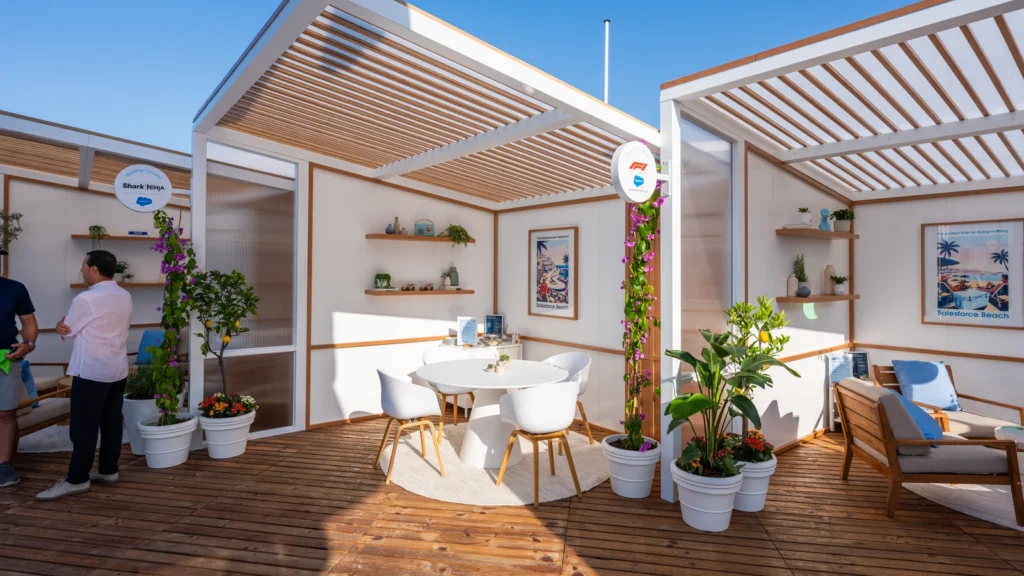
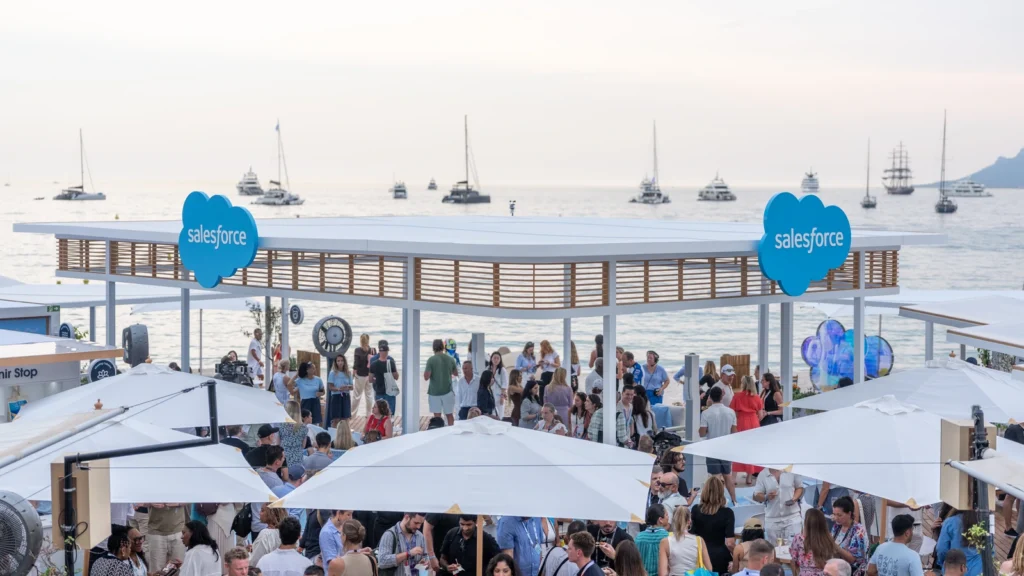
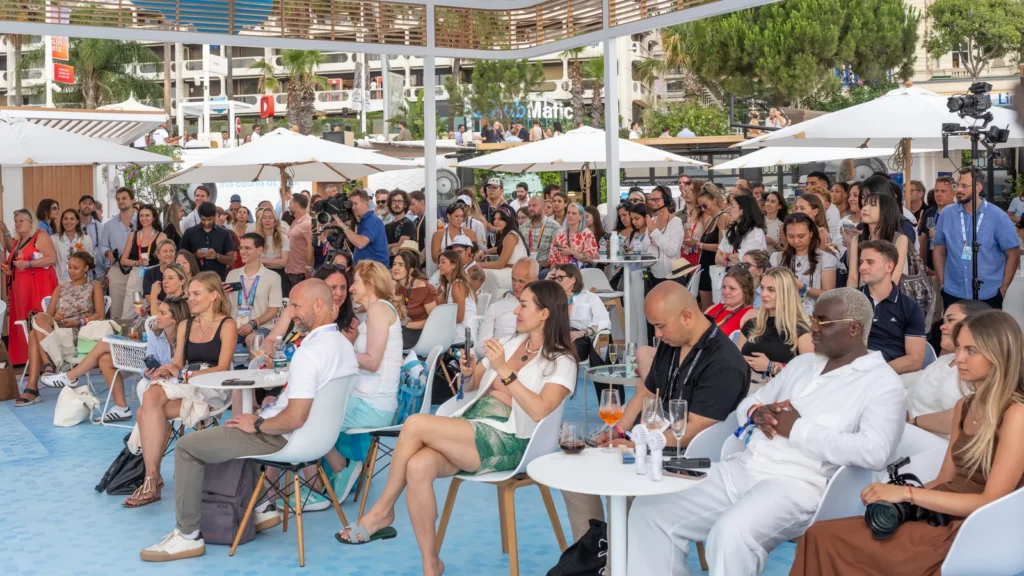
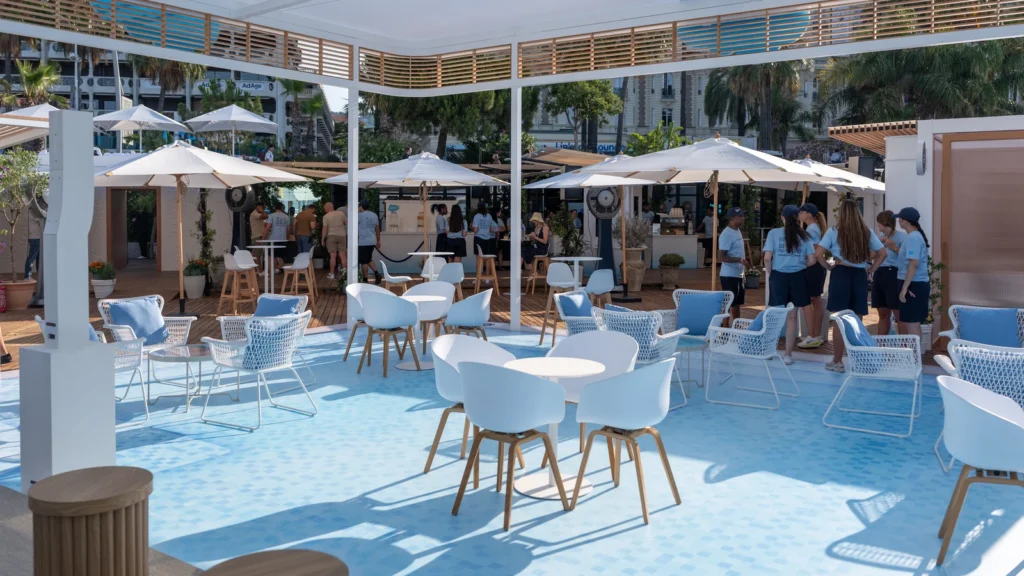
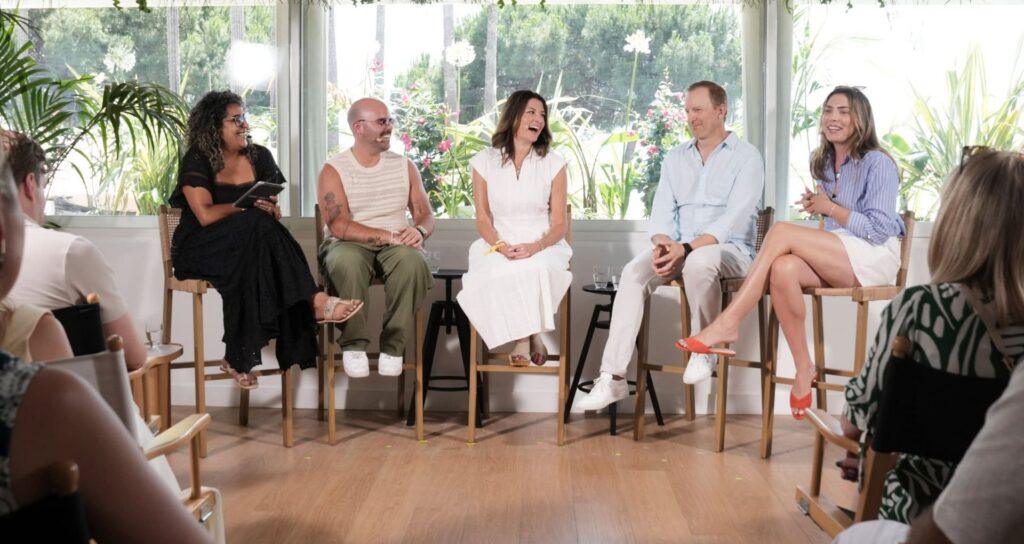
At the heart of the space sat the main canopy, a sweeping white structure over a deck lounge with the Salesforce cloud marked on each side. Sparks designed it to carry the whole day. It opened as a lounge, set up as a stage for the panels and fireside chats, reset into an intimate CMO Experience seating around two dozen or a brunch for forty at round tables, and after the talks turned into an evening venue with a happy hour and DJ sets.
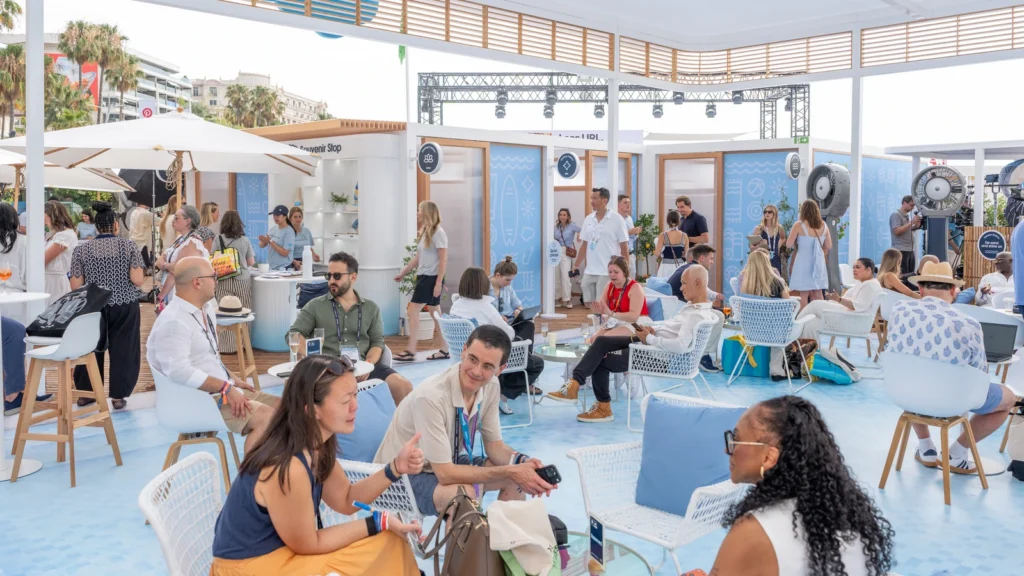
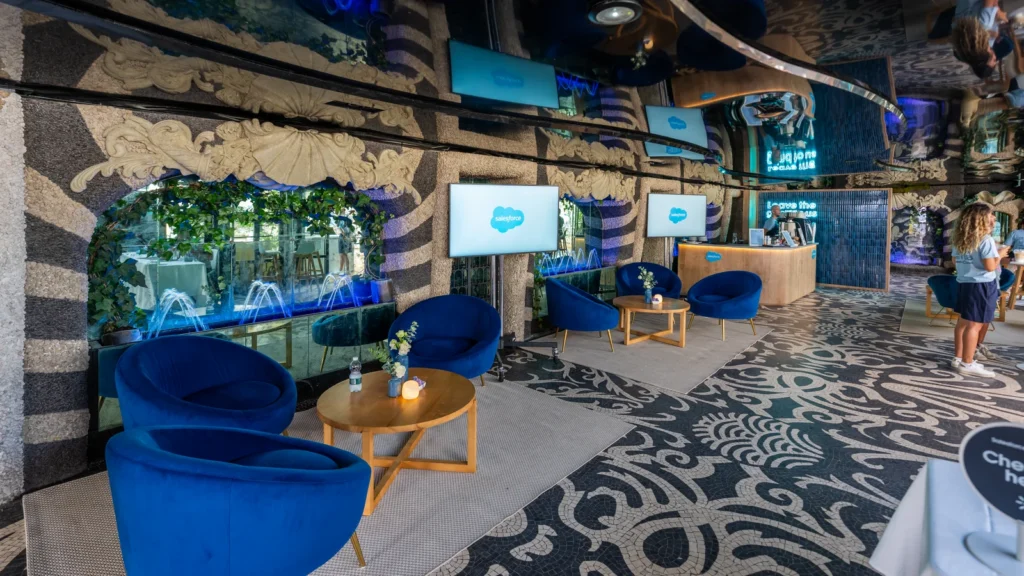
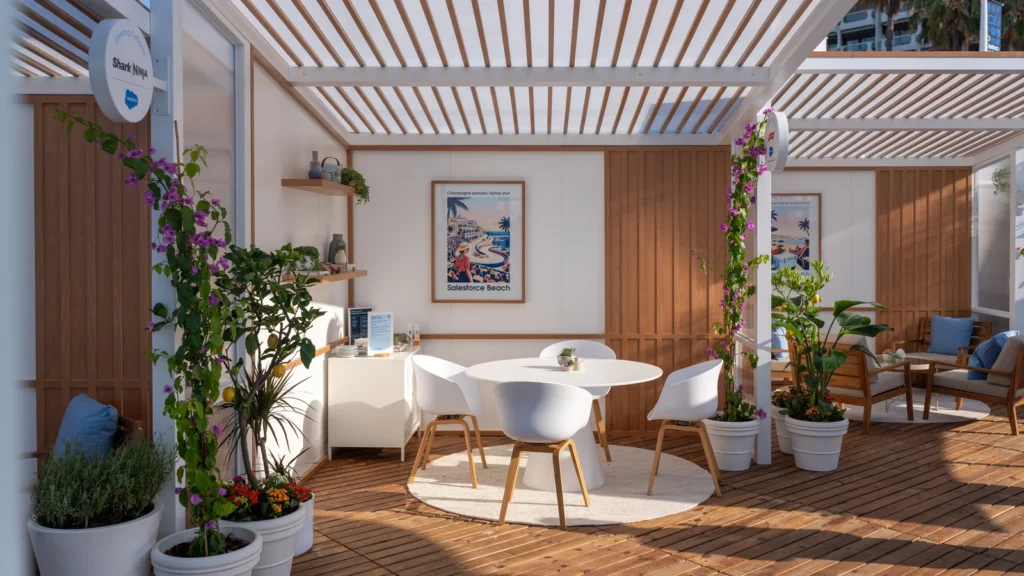
Around the main space, Sparks built twelve distinct meeting settings to suit the range of conversations a week at Cannes demands. Open-air cabanas and lounge seating was placed alongside enclosed, air-conditioned rooms for private meetings, several of which could combine to form larger spaces. An executive lounge, set over a patterned mosaic floor under blue neon, gave senior guests a room off the main floor. Attendees could easily move between the settings that felt most appropriate for their needs, from a casual catch-up to a sensitive, executive-level conversation.
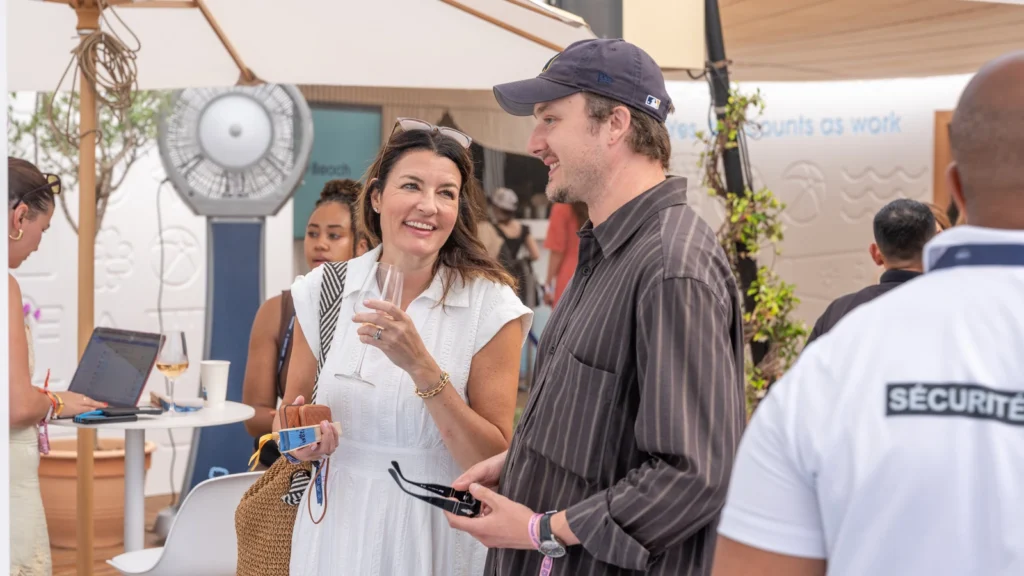
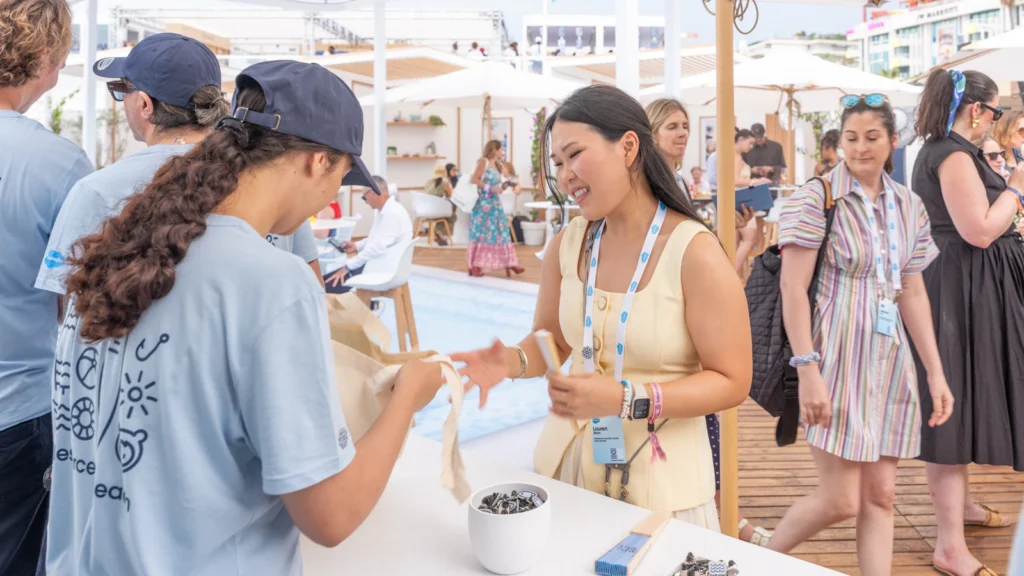
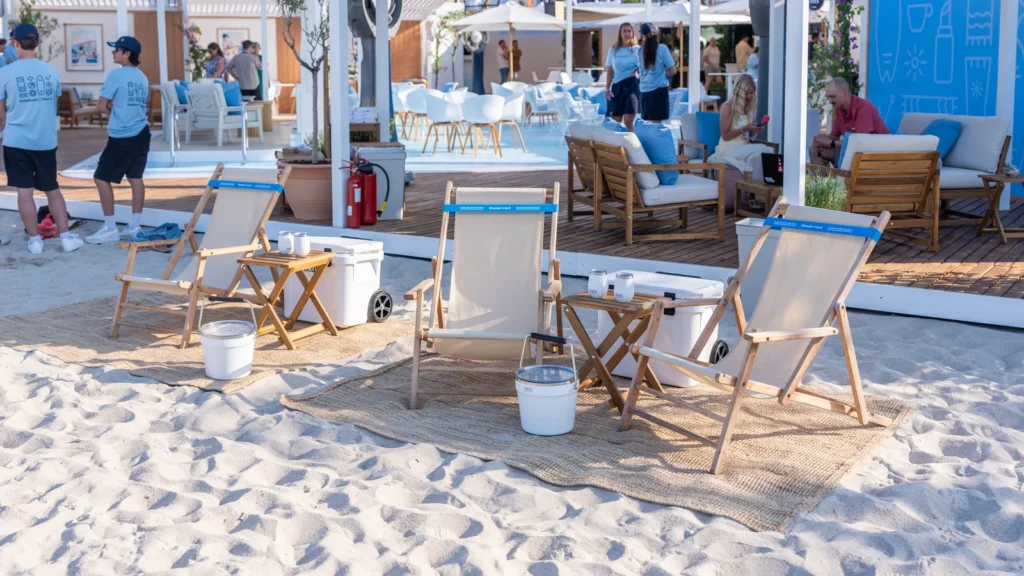
A space like Salesforce Beach works only if people linger. To make guests feel at home, Sparks built several refreshment areas, including a general-admission bar and café, a souvenir shop, shaded beach vignettes, and a foot-wash station, “De-sand and shine on,” for anyone coming up from the water. Each was finished in the same materials as the meeting rooms, so the busy public stretches and the private ones felt connected to each other as one, cohesive experience.
Throughout the four days, a Sparks photographer worked the space from open to close, capturing the empty build at dawn, candid photos as the crowd arrived, and the energy of the evening happy hours. The footage fed a final sizzle reel and gave Salesforce a library of polished imagery to use long after the build came down.
The Impact
Salesforce Beach put the brand front and center of its core audience at one of the most important events of the year, and the deeper measure of a space like this isn’t foot traffic.
Sparks’s parent organization, the Freeman Company, has a name for what a space like this is built to move: The Belief Gap™, the distance between brand awareness and genuine belief in its promise. In Freeman’s research, 45% of CMOs named live events as the best way to close it. To Sparks, that gap is exactly what a physical space is built to close.
If human connection is what closes the gap, AI is what makes that connection possible at scale. On a panel at the Wall Street Journal’s Journal House, Salesforce’s Erin Oles explained how the company uses its own AI to help customers cut through a massive program and find the sessions that are most relevant to them, based on their individual interests and priorities.
“AI lets us make an event more personal than ever before. Instead of putting customers in a broad category and guessing what they’ll like, we can do one-to-one targeting. The AI looks at exactly who they are, scans everything it knows about them instantly, and recommends the sessions they’ll actually care about. If a person browses a thousand sessions themselves, they hit fatigue and move on. AI doesn’t. We found that when customers use our AI tool to build their agenda, they’re 30% more likely to show up. Even better, if they make it into a session about a product they’re interested in, the data tells us that those deals close 70% faster.” – Erin Oles, SVP, Global Integrated Marketing, Salesforce
The room was the argument. Salesforce came to Cannes to talk about creativity and the power of AI in marketing. The most convincing version of that argument wasn’t in a speech or a keynote, it was a space that looked and worked the way the company says good marketing should. The destination made that case on its own, before a single panel began. And the room people walked into wasn’t the Salesforce they expected.
“This isn’t the same Salesforce it was a year ago and people are often surprised we’re even here. Cannes is a new arena for us. That’s the point: we want to move from being a technologically relevant brand to a culturally relevant one, and showing up in a space like this, in a conversation like this, is how that shift becomes real.” — Jeffrey Limon, VP of Events and Experiences, Salesforce
A home base changes your posture. Much of the real business at Cannes happens in passing: a conversation between sessions, an introduction on the way to lunch. Owning a fixed, comfortable base meant Salesforce didn’t have to chase those moments up and down the Croisette. Instead, it could bring the week to its own doorstep. For four days the company hosted the industry instead of moving through it, and being the place people come to is an advantage no schedule can buy.
Generosity does its own persuading. Four days at Cannes is a marathon: long hours, full calendars, the Riviera heat in June. A base that offered shade, a refreshing drink, a place to connect, and a rinse for sandy feet. Hospitality like that earns what a pitch can’t: a guest who’s been taken care of arrives at the next conversation warmer, and readier to hear what the brand has to say.
Client Quote
A Note on Partners
Salesforce owned its presence at Cannes Lions 2026: its brand, its agenda, its speakers, and its guests. Sparks served as the design-and-build and production partner for Salesforce Beach, responsible for the physical environment, the meeting and hospitality spaces, the activations, the wayfinding, and the on-site content capture that brought the destination to life and kept it running across four days on the beach.
Featured in The Wall Street Journal
Turning Brand Awareness Into Belief
In a new WSJ feature on experiential marketing, Sparks President Melissa Levy joins Salesforce’s Erin Oles to discuss how brands like Salesforce use live events — from Dreamforce to Salesforce Beach — to build pipeline, measure ROI, and strengthen visibility in an AI-driven search landscape.
Frequently Asked Questions
The Cannes Lions International Festival of Creativity is the marketing and advertising industry’s leading annual event. Held each June in Cannes, France, it gathers brands, agencies, and media and technology companies for five days of talks, awards, and client hospitality along the French Riviera. Much of the week’s business happens at beachfront activations and brand destinations along the Croisette, the city’s seafront boulevard.
Salesforce Beach was Salesforce’s beachfront destination at Cannes Lions 2026, located on Annex Beach off La Croisette. Open across four days of the festival, it combined private client meeting spaces, a stage for panels and fireside chats, food and beverage service, interactive activations, and evening programming, all built around Salesforce’s themes of creativity and AI in marketing.
Sparks was the design-and-build and production partner for the destination, responsible for the environment design and build, the twelve meeting spaces, the activations, the brand environments and wayfinding, and on-site content capture. Salesforce owned the event, its programming, and its guest list; Sparks designed, built, and ran the space around them.
Sparks designs and builds brand experiences across a wide range of formats and scales, from large conferences and exhibitions to multi-day activations and hospitality destinations at major industry events. Each is built around the brand, its audience, and the setting.
Many brands host clients at Cannes Lions through beachfront activations, private houses, and hospitality spaces along the Croisette. Building one means turning a temporary footprint into a working venue: meetings, programming, food and beverage, and brand experience together, produced to run for several days. Brands often work with a design-and-build partner to design, fabricate, and operate the space end to end.
Yes. Sparks regularly designs and builds large-scale brand environments in demanding settings, including temporary destinations on open beaches. Salesforce Beach, a multi-day destination built on Annex Beach in Cannes, was designed, fabricated, and run by Sparks from the boulevard entrance to the water’s edge.
The Belief Gap™ is a framework from the Freeman Company describing the distance between brand awareness and genuine brand belief: the difference between people knowing a brand and actually trusting its promise. In Freeman’s research, 45% of CMOs identified live events as the most effective way to close that gap, because face-to-face, human connection builds a kind of trust that digital channels struggle to replicate. Brand destinations like Salesforce Beach are designed to close it through direct, in-person experience.
Success at an experiential event is measured less by attendance and more by behavior: what guests do during and after the experience. Beyond foot traffic and dwell time, marketers track medium-term signals like movement through the sales funnel, brand consideration, and post-event actions such as new sales conversations or maturing pipeline. As Salesforce’s Erin Oles put it on a WSJ Journal House panel, the real proof is whether attendees “move with their actions afterwards, with meetings and business decisions.”
AI is increasingly used both as a subject of live events and as a tool to run them. As a theme, brands like Salesforce use experiences to make abstract AI products tangible; as a tool, AI personalizes event experiences: Salesforce has used its own agentic AI at its Dreamforce conference to recommend sessions and tailor agendas in real time. The throughline is that AI is making in-person experiences more personal, not less necessary.
Technology companies typically work with specialized experiential and design-and-build agencies to create their brand experiences at events and conferences. These partners handle concept and creative design, environment fabrication, production, and on-site operation. Sparks, for example, has built experiences for technology brands including Salesforce, designing and producing destinations end to end.